 Simple Pay Application
Lien waivers: the four kinds and the State forms
A lien waiver is a paper a sub or supplier signs to give up lien rights for a payment. GCs and owners ask for one with each pay app. There are four kinds: conditional or unconditional, on a progress or a final payment. Twelve States print the wording in their statutes, and the amount and date come from the pay app.
This is the hub for everything about waivers on this site. It sets the four kinds side by side, lists the States whose statutes print a form, and follows one electrical job from its pay app to the waiver it produces, figure by figure.
The four kinds side by side
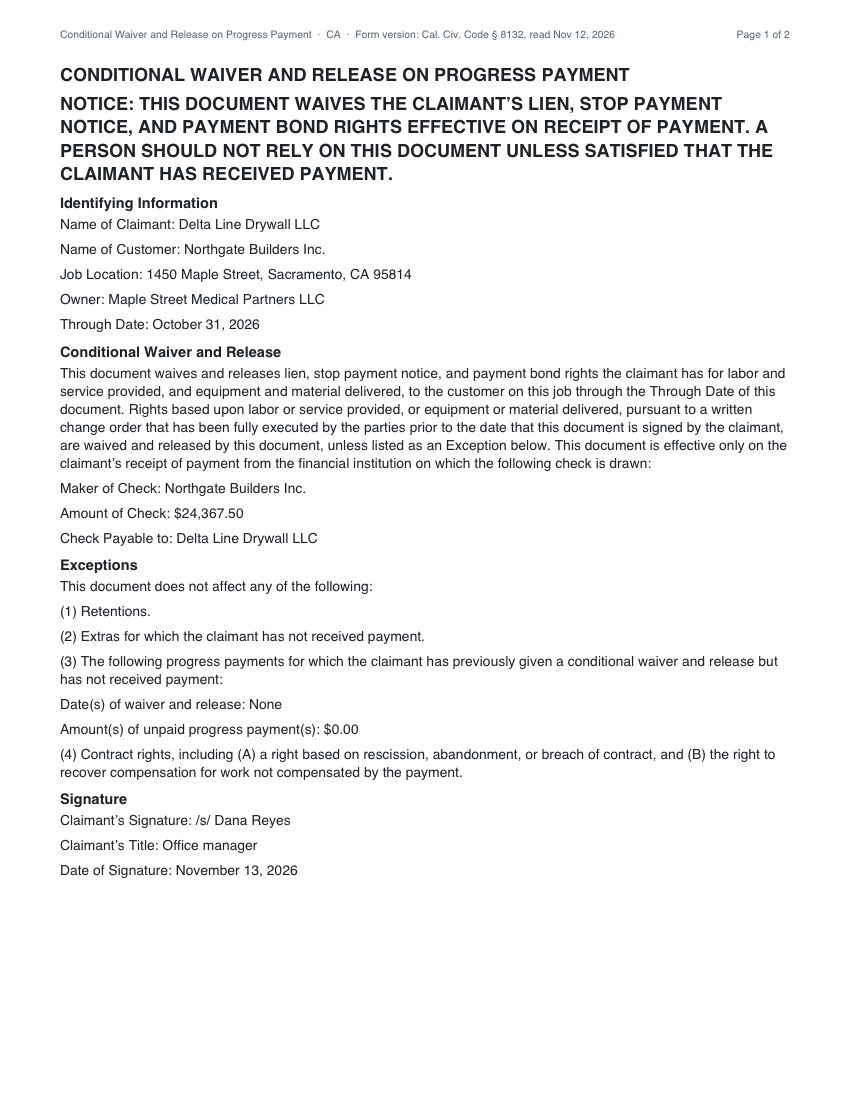
Two choices make the four kinds. The first is timing: a conditional waiver takes effect when the payment it names arrives, and an unconditional waiver takes effect when it is signed. The second is scope: a progress waiver covers work through a stated date, and a final waiver covers the whole job. The table uses California’s four forms as the model, because that statute prints all four.
| Kind | Takes effect | Payment line | Work it covers | Often sent |
|---|---|---|---|---|
| Conditional, progress | On receipt of the payment it names | Maker of the check, amount, payee | Through the stated date | With the pay app, before the money |
| Unconditional, progress | When signed | The progress payment received | Through the stated date | After the check has cleared |
| Conditional, final | On receipt of the payment it names | Maker of the check, amount, payee | The whole job | With the last pay app |
| Unconditional, final | When signed | A statement that the claimant has been paid in full | The whole job | After the final check has cleared |
California’s unconditional forms open with a notice to the claimant: THIS DOCUMENT IS ENFORCEABLE AGAINST YOU IF YOU SIGN IT, EVEN IF YOU HAVE NOT BEEN PAID
. The conditional forms carry a different line in its place: This document is effective only on the claimant’s receipt of payment from the financial institution on which the following check is drawn
. The page on conditional vs unconditional covers the timing in more detail.
Every kind names the same parties: the claimant who signs, the customer who pays the claimant, the job location and the owner. A progress form adds a through date. A final form leaves it out, because it covers all the work. The last section of each California form lists what the waiver does not affect, which is where retentions, unpaid extras and disputed claims appear.
How the waiver follows the pay app
A waiver is a receipt for a payment, so it carries the payment’s figures. Two of them come straight from the pay application: the amount is the pay app’s current payment due, which is line 8 of the summary, and the through date is the period end date the pay app was billed to. The names come from the account and the project. In the app the waiver is made from a finished pay app, so nothing is typed a second time and the amount starts out as the one that was asked for.
The gap between the contract sum and the waiver amount is large on purpose. The waiver does not name the total earned or the contract value. It names the check, which is the total earned, less retainage held, less what earlier pay apps asked for. The worked example below makes that gap visible.
A worked example: the waiver for pay app 2 on an electrical job
An electrical sub has a $200,000 contract with retainage held at 10% on work and 5% on materials stored on site. Its second pay app is for the period to April 30, 2026. Rough-in labor moves along, the switchgear arrives and goes in, and some fixtures are installed while more are delivered. This is the continuation sheet that the waiver follows.
| Line | Scheduled value | From earlier apps | This period | Stored | Total to date | % | Balance to finish | Retainage |
|---|---|---|---|---|---|---|---|---|
| 1 Rough-in labor | 60,000.00 | 18,000.00 | 24,000.00 | 0.00 | 42,000.00 | 70.00 | 18,000.00 | 4,200.00 |
| 2 Switchgear | 85,000.00 | 0.00 | 60,000.00 | 0.00 | 60,000.00 | 70.59 | 25,000.00 | 6,000.00 |
| 3 Fixtures | 40,000.00 | 0.00 | 8,000.00 | 9,000.00 | 17,000.00 | 42.50 | 23,000.00 | 1,250.00 |
| 4 Trim-out | 15,000.00 | 0.00 | 0.00 | 0.00 | 0.00 | 0.00 | 15,000.00 | 0.00 |
| Totals | 200,000.00 | 18,000.00 | 92,000.00 | 9,000.00 | 119,000.00 | 81,000.00 | 11,450.00 |
The stored materials are the interesting part. On the switchgear line, $52,500.50 of this period’s $60,000 is switchgear that was billed as stored on the first pay app and went into the building this month. It leaves the stored column and enters this period’s work, so the line’s total grows only by what is new. On the fixtures line, $8,000 was installed from stock and $5,000 more was delivered. Retainage on that line is $800 on the work at 10% plus $450 on the stored fixtures at 5%, which is $1,250.
| 1Original contract sum | $200,000.00 |
| 2Net change by change orders | $0.00 |
| 3Contract sum to date | $200,000.00 |
| 4Total completed and stored to date | $119,000.00 |
| 5Retainage, $11,000 on work and $450 on stored materials | $11,450.00 |
| 6Total earned less retainage | $107,550.00 |
| 7Less previous applications | $77,475.47 |
| 8Current payment due | $30,074.53 |
| 9Balance to finish, including retainage | $92,450.00 |
Line 8 is the figure the waiver is built on. The rows add up to $119,000 of work and stored material, retainage takes $11,450 off, and the first pay app’s $77,475.47 comes off again, which leaves $30,074.53. Line 9 shows $92,450.00 still to bill, and that includes the $11,450 held.
The waiver this pay app produces
For a conditional progress waiver, each blank has a known source in the pay app. The table shows what lands in it for this job.
| Blank on the form | What goes in | Where it comes from |
|---|---|---|
| Through date | April 30, 2026 | The period end date of pay app 2 |
| Amount of check | $30,074.53 | Line 8, current payment due |
| Name of claimant | The electrical sub | The account’s company name |
| Customer, job location, owner | The GC, the site, the owner | The project |
| Exceptions | Any earlier conditional waiver not yet paid | The list of this account’s earlier waivers, with their pay apps |
The $11,450 of retainage is not in the $30,074.53, so it is not part of this payment. California’s progress forms list retentions among the things they do not affect, and other forms print their own exceptions. Once the check has cleared, the same pay app’s earlier payment, $77,475.47 on line 7, is the figure for the unconditional progress waiver that confirms it, if the GC paid pay app 1 as asked.
The words on a waiver and the arithmetic behind them
These are the figures that reach a waiver and the ones that stay behind on the pay app. Reading them in order is the quickest way to see why a waiver and its pay app always agree.
| Term | What it is | How it is worked out |
|---|---|---|
| Contract sum to date | The contract as it stands now | The original contract sum, plus change orders signed by both parties, less deducting ones. Not on the waiver |
| Total completed and stored | Everything earned so far | Earlier work, plus this period, plus materials still stored. Not on the waiver |
| Retainage | The share held back until the end | One rate on work and one on stored materials, rounded on each line, then added. Held outside the payment, so it sits among the waiver’s exceptions |
| Total earned less retainage | Earned in cash so far | The total completed and stored, less the retainage held. Not on the waiver |
| Less previous applications | What earlier pay apps asked for | Carried forward from the last finished pay app. Matches the payments earlier waivers named |
| Current payment due | The payment being asked for | The total earned less retainage, less the previous applications. This is the amount on the waiver |
| Through date | The day the waiver runs through | The pay app’s period end date, copied |
| Balance to finish | What is left to bill | The contract sum to date, less the total earned less retainage. Not on the waiver |
| Unpaid earlier waivers | Conditional waivers whose checks have not arrived | Listed by date and amount on the conditional progress form’s exception line |
Twelve States print the wording, the rest use our general forms
In 12 States the statute prints a form, or several. There the app prints the statute’s wording word for word, with the section number and the date we read it, and only the blanks change. Everywhere else the app offers our general forms: the same four kinds, in our own wording, with the same blanks filled from the pay app. The project’s State picks which set appears.
The States do not all have four forms. The table gives each State’s statute, what it prints, what its statute says about using the form and what it says about a notary, as read on Nov 12, 2026. Each State has a page that prints every one of its forms in full.
| State | Statute | Forms it prints | Use of the form | Notary |
|---|---|---|---|---|
| Arizona | A.R.S. § 33-1008(D) | Four: conditional and unconditional, progress and final | Yes: a waiver is to be substantially in the statute’s form. | The statute is silent. |
| California | Cal. Civ. Code §§ 8132, 8134, 8136, 8138 | Four: conditional and unconditional, progress and final | Yes: a waiver is unenforceable unless it is in substantially the statute’s form (8132-8138). | The statute is silent. |
| Florida | Fla. Stat. § 713.20(4), (5) | Two: progress and final, not called conditional or unconditional | No: the statute gives forms a waiver may follow, and no one may require a different form (713.20(6)). The statute’s two forms are for progress and final payments; it does not call them conditional or unconditional. | The statute is silent. |
| Georgia | O.C.G.A. § 44-14-366 | Interim and final waivers, plus an affidavit of nonpayment | Yes: a waiver is enforceable only on a form that substantially follows the statute’s language, and only once payment is made as the statute sets out (44-14-366(c), (d), (e)). | The waiver forms have witness and address lines; the affidavit of nonpayment has a notary line. |
| Massachusetts | M.G.L. c. 254, s. 32(4) | One: partial waiver and subordination of lien | The statute gives the form. | Signed under the penalties of perjury; the statute names no notary. |
| Michigan | MCL 570.1115(9) | Four, named partial and full: conditional and unconditional | Yes: the forms are to be used in substantially the statute’s format. | The statute is silent. |
| Mississippi | Miss. Code § 85-7-433 | Interim and final waivers, plus an affidavit of nonpayment | The section does not say; section 85-7-419, which it refers to, was not read. The forms’ notice says a form without it is not enforceable. | Each waiver form and the affidavit of nonpayment carry a notary block. |
| Missouri | RSMo 429.016 (subsection 27) | One: unconditional final, for residential real property | Yes, for an unconditional final waiver on residential real property: it is valid only on a form substantially like the statute’s. The statute sets no form for the other kinds. | The statute is silent. |
| Nevada | NRS 108.2457(5) | Four: conditional and unconditional, progress and final | Yes: other forms are not enforceable. | The statute is silent. |
| Texas | Tex. Prop. Code § 53.284 | Four: conditional and unconditional, progress and final | Yes: a waiver is unenforceable unless it substantially complies with the statute’s form. | The statute is silent; it asks for the claimant’s or an authorized agent’s signature. |
| Utah | Utah Code § 38-1a-802(4) | Two: conditional progress and final | The statute gives forms a waiver may substantially follow. The statute has no unconditional forms; our general forms are offered for those. | The statute is silent. |
| Wyoming | W.S. 29-10-101(b) | One: a single lien waiver for progress and final payments | The statute gives one form, to be substantially followed. One form for progress and final payments alike. | The form has a notary acknowledgment block. |
Some patterns in the table are worth knowing. Arizona, California, Nevada and Texas print all four kinds, and Michigan prints four under the names partial and full. Georgia and Mississippi use interim and final waivers instead, and each also prints an affidavit of nonpayment. Florida’s two forms are for progress and final payments. Massachusetts has one form, Missouri’s statute covers only the unconditional final waiver on residential property, Utah’s covers conditional waivers only, and Wyoming has one form for both progress and final. For the kinds a State does not print, the app offers our general form.
Why waivers and pay apps get kicked back, and what the app checks
A pay app held up for a waiver problem waits for the next cycle, the same as one held up for arithmetic. The causes are mostly two papers that show different figures for the same thing. The table lists the usual ones and says what the app does about each.
| Reason it comes back | What the app does |
|---|---|
| The waiver amount differs from the payment due | Makes the waiver from the finished pay app and fills the amount from line 8, to the cent |
| The through date is not the period end | Fills the through date from the pay app’s period end date |
| Totals that do not tie to the contract | Blocks finishing the pay app until the SOV total equals the contract sum to date, so the waiver is never made from an untied pay app |
| Retainage worked on the wrong base | Applies one rate to work and one to stored materials, rounds each line, then adds the lines |
| Stored materials counted twice | Moves installed material out of stored and into work, and blocks installing more than was stored |
| Change orders not signed by both parties | Shows change orders signed by both parties apart on the summary and gives each its own line from the next pay app |
| The State’s own form was not used | Prints the statute’s wording in the 12 States, chosen by the project’s State |
| No waiver with the pay app | Puts the waiver and the backup files into the same PDF as the pay app |
| The wrong kind of waiver was picked | Not a check: the kind is the signer’s choice, and the app prints the one picked |
The engine behind these checks is tested against twelve worked jobs, each figured by hand to the cent, so the amount on a waiver can be traced back to a pay app line that was checked.
Making a lien waiver here
- Finish the pay app that the payment is for.
- Choose the kind: conditional or unconditional, on a progress or a final payment.
- Read the amount, the through date and the exceptions on the form.
- Sign it typed or drawn, or send a signing link to the person who signs.
- Download the waiver in the same PDF as the pay app and its backup.
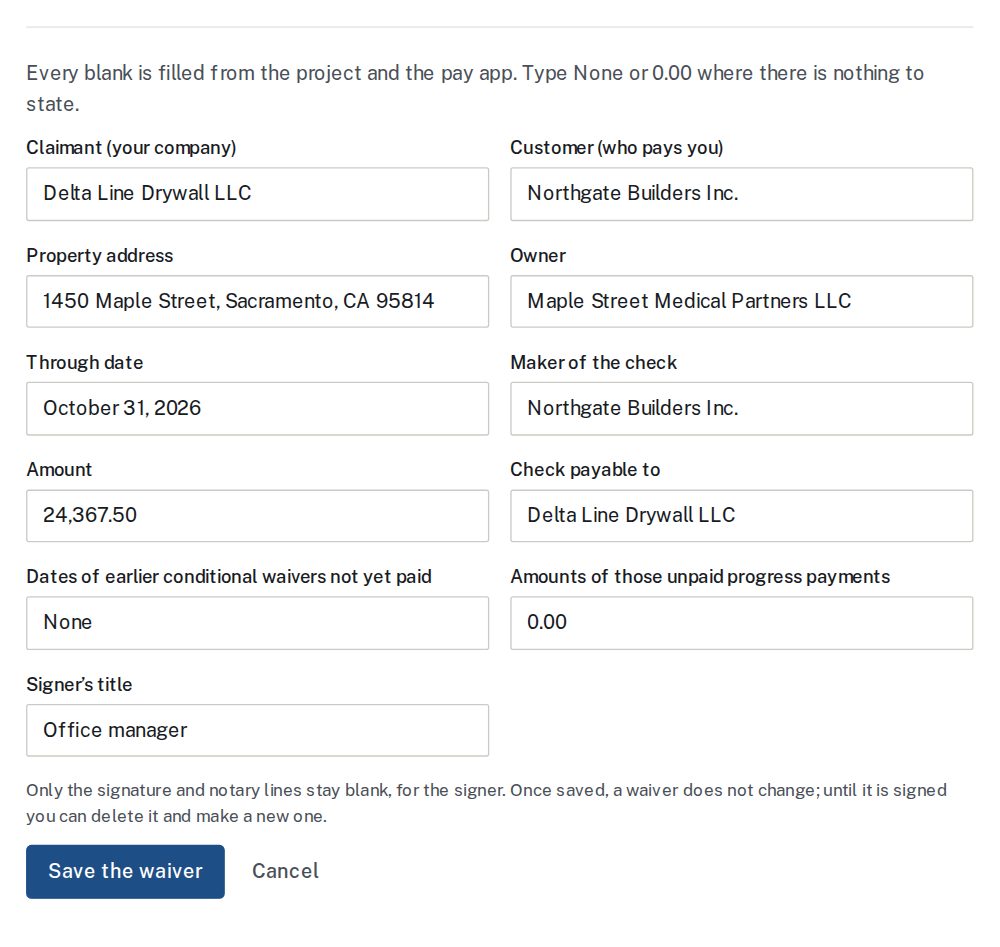
The screen above is California’s conditional progress form. In every State the form opens with the blanks already filled from the pay app, and the exceptions are left for the signer to check. The lien waiver form page covers the signing step in more detail, and the California page prints that State’s four forms in full.
Signing and sending
The signer can type or draw a signature in the app, or the app can send a signing link to the person who signs. Where a State form has a notary block, it prints for a notary to complete; notarizing itself happens outside the app. The waiver goes into the same PDF as the pay app, with any backup files attached.
The final waiver and the retainage release
The last pay app on a job usually releases the retainage, and the final waiver follows it. A release is entered on the pay app and cannot be more than the retainage held. When all the work is billed, the payment due on that pay app is the retainage released, and a final waiver made from it names that payment, the same way a progress waiver names its pay app’s payment. The retainage guide follows a job through that release with its own figures.
State directory
Each page prints the State’s forms in full, with the statute section and the date read.
Lien waiver questions
What is a lien waiver?
A signed paper in which a sub or supplier gives up lien rights for a payment. Owners and GCs ask for one with each payment. It names the claimant, the customer, the job, an amount and a date.
What is the difference between conditional and unconditional?
Timing. A conditional waiver takes effect when the payment it names is received. An unconditional waiver takes effect when it is signed, and California's form says plainly that it binds the signer even if the money has not arrived.
Which States print the waiver wording?
Twelve: Arizona, California, Florida, Georgia, Massachusetts, Michigan, Mississippi, Missouri, Nevada, Texas, Utah and Wyoming. Each State page prints its forms in full, with the statute section and the date we read it. In every other State the app offers our general forms.
Which amount goes on the waiver?
The pay app's current payment due, which is line 8 of the summary. On the electrical job above that is $30,074.53, not the $119,000 of work to date, because retainage and earlier payments come off first.
Does a progress waiver cover retainage?
California's two progress forms list retentions first among the things the document does not affect. Other States' forms print their own exceptions, and the State pages show them.
Does a lien waiver need a notary?
It depends on the State. Mississippi's forms and affidavit carry a notary block, Wyoming's form has a notary acknowledgment, and Georgia's waiver forms have witness lines. Massachusetts' form is signed under the penalties of perjury, and Arizona, California, Florida, Michigan, Missouri, Nevada, Texas and Utah say nothing about a notary in the sections we read.
What if my State is not one of the twelve?
The app offers our general forms, in the same four kinds, with the same blanks filled from the pay app.
Can the person who signs do it from a link?
Yes. The signer can type or draw a signature in the app, or the app can send a signing link to the person who signs.
Sources: California Civil Code 8132, Texas Property Code chapter 53.
Related guides
The waiver’s amount comes from the pay application, and the conditional progress waiver is the kind often sent with it. For the retainage that stays outside every progress payment, see retainage.
The page prints each State’s wording and the facts as read; choosing which waiver to sign is up to the signer.