 Simple Pay Application
Conditional vs unconditional lien waivers
A conditional lien waiver takes effect only when the payment it names is received. An unconditional one takes effect when it is signed, whether or not the money has arrived. Over a job the two follow each other: a conditional waiver goes with a pay app, and the unconditional waiver for that payment follows once it has been paid.
The difference is easiest to see in time, so this guide follows one concrete job through two pay apps and says which waiver goes with which payment. It quotes the California statute for the words that make the difference, and shows what the app fills in on each waiver.
The job: a concrete sub, pay apps 2 and 3
A concrete sub has a $160,000 contract with 10% retainage. Its first pay app asked for $64,800.00: footings in full and a quarter of the slab. The second pay app, for the period to June 30, 2026, adds more slab and a change order signed by both parties, a thickened slab at the loading dock for $12,500.00 that becomes its own line.
| Line | Scheduled value | From earlier apps | This period | Total to date | Retainage |
|---|---|---|---|---|---|
| 1 Footings | 48,000.00 | 48,000.00 | 0.00 | 48,000.00 | 4,800.00 |
| 2 Slab on grade | 96,000.00 | 24,000.00 | 48,000.00 | 72,000.00 | 7,200.00 |
| 3 Curbs | 16,000.00 | 0.00 | 0.00 | 0.00 | 0.00 |
| 4 CO 1: Thickened slab at loading dock | 12,500.00 | 0.00 | 6,250.00 | 6,250.00 | 625.00 |
| Totals | 172,500.00 | 72,000.00 | 54,250.00 | 126,250.00 | 12,625.00 |
| 1Original contract sum | $160,000.00 |
| 2Net change by change orders | $12,500.00 |
| 3Contract sum to date | $172,500.00 |
| 4Total completed and stored to date | $126,250.00 |
| 5Retainage held | $12,625.00 |
| 6Total earned less retainage | $113,625.00 |
| 7Less previous applications | $64,800.00 |
| 8Current payment due | $48,825.00 |
| 9Balance to finish, including retainage | $58,875.00 |
The third pay app, for the period to July 31, 2026, finishes the slab, bills three quarters of the curbs and the rest of the change order line. It also carries a second change order, a credit of $4,000.00 for deleting the east curb, which enters as a line with a negative value.
| Line | Scheduled value | From earlier apps | This period | Total to date | Retainage |
|---|---|---|---|---|---|
| 1 Footings | 48,000.00 | 48,000.00 | 0.00 | 48,000.00 | 4,800.00 |
| 2 Slab on grade | 96,000.00 | 72,000.00 | 24,000.00 | 96,000.00 | 9,600.00 |
| 3 Curbs | 16,000.00 | 0.00 | 12,000.00 | 12,000.00 | 1,200.00 |
| 4 CO 1: Thickened slab at loading dock | 12,500.00 | 6,250.00 | 6,250.00 | 12,500.00 | 1,250.00 |
| 5 CO 2: Delete east curb (credit) | -4,000.00 | 0.00 | -4,000.00 | -4,000.00 | -400.00 |
| Totals | 168,500.00 | 126,250.00 | 38,250.00 | 164,500.00 | 16,450.00 |
| 1Original contract sum | $160,000.00 |
| 2Net change by change orders | $8,500.00 |
| 3Contract sum to date | $168,500.00 |
| 4Total completed and stored to date | $164,500.00 |
| 5Retainage held | $16,450.00 |
| 6Total earned less retainage | $148,050.00 |
| 7Less previous applications | $113,625.00 |
| 8Current payment due | $34,425.00 |
| 9Balance to finish, including retainage | $20,450.00 |
Which waiver goes with which payment
Each waiver names one payment. On this job the payments are $48,825.00 for pay app 2 and $34,425.00 for pay app 3. Those are the line 8 figures, after retainage, and not the $54,250.00 and $38,250.00 of work billed in the two periods. The table follows the money in the order it happens.
| When | Waiver | Amount | Through date |
|---|---|---|---|
| Pay app 2 goes out | Conditional progress, sent with the pay app | $48,825.00 | June 30, 2026 |
| The check for pay app 2 clears | Unconditional progress, signed now that the money is in | $48,825.00 | June 30, 2026 |
| Pay app 3 goes out | Conditional progress, sent with the pay app | $34,425.00 | July 31, 2026 |
| The check for pay app 3 clears | Unconditional progress, signed now that the money is in | $34,425.00 | July 31, 2026 |
| The last pay app goes out | Conditional final, with the final payment named | The final payment due | All the work, so none |
| The final check clears | Unconditional final, saying paid in full | None on the form | All the work, so none |
This is one common order. A contract or a GC can ask for a different one, and the contract is where the order is set. What the app does is fixed: a conditional waiver takes its amount and date from the pay app it is made from, and an unconditional progress waiver takes them from the pay app before it, since that is the payment already received. Made from pay app 3, the unconditional waiver opens with $48,825.00 and June 30, 2026, which are pay app 2’s figures. Any blank can be edited before the waiver is saved.
What the California statute says about timing
California prints all four forms in its Civil Code, and the two that differ in timing carry their difference in words. The conditional progress form says the document is effective only on receipt of the check: This document is effective only on the claimant’s receipt of payment from the financial institution on which the following check is drawn:
(Civil Code 8132). Its notice adds A PERSON SHOULD NOT RELY ON THIS DOCUMENT UNLESS SATISFIED THAT THE CLAIMANT HAS RECEIVED PAYMENT.
The unconditional progress form turns this round. Its notice to the claimant reads THIS DOCUMENT IS ENFORCEABLE AGAINST YOU IF YOU SIGN IT, EVEN IF YOU HAVE NOT BEEN PAID. IF YOU HAVE NOT BEEN PAID, USE A CONDITIONAL WAIVER AND RELEASE FORM.
(Civil Code 8134). Instead of a check, it states what was received: The claimant has received the following progress payment: $
- Statute
- Cal. Civ. Code §§ 8132, 8134, 8136, 8138
- Use of the form
- Yes: a waiver is unenforceable unless it is in substantially the statute’s form (8132-8138).
- Who it applies to
- Any claimant asked to sign a waiver in exchange for, or to induce, a payment (8132-8138).
Source: Cal. Civ. Code §§ 8132, 8134, 8136, 8138. California Legislative Information (leginfo.legislature.ca.gov), read Nov 12, 2026.
The California page prints the four forms in full.
Earlier waivers that were never paid
A job runs for months, and a check for one pay app can be late while the next pay app is already out. California’s conditional progress form has a place for exactly that, an exception for The following progress payments for which the claimant has previously given a conditional waiver and release but has not received payment:
followed by the dates and amounts. The unconditional progress form has no such line. On the concrete job, if the check for pay app 2 were still outstanding when pay app 3 went out, that line would carry June 30, 2026 and $48,825.00. The app leaves those two blanks as lines on the PDF, for the signer to complete.
Retainage and change orders across the sequence
After pay app 3 the job holds $16,450.00 of retainage, and neither progress waiver names it. California’s progress forms list it first among the things they do not affect: Retentions.
The final waivers are where it comes up again, since the last payment usually includes the release. The retainage guide shows a release billed at the end of a job.
Change orders show in the waivers through one clause. California’s forms release work done under a written change order that has been fully executed by the parties prior to the date that this document is signed by the claimant
unless it is listed as an exception. The statute’s words turn on the date the change order was signed by both parties against the date the waiver is signed. On the concrete job the second change order is a credit. It lowers the contract sum by $4,000.00 and moves line 2 from $12,500.00 to $8,500.00, and no waiver lists it by number, since a waiver names an amount and a through date.
The four kinds on one job
| Kind | Takes effect | What it says about payment |
|---|---|---|
| Conditional progress | On receipt of the payment named | Names the amount to be paid |
| Unconditional progress | When signed | States the amount received |
| Conditional final | On receipt of the final payment | Names the final amount, with disputed claims as an exception |
| Unconditional final | When signed | States payment in full |
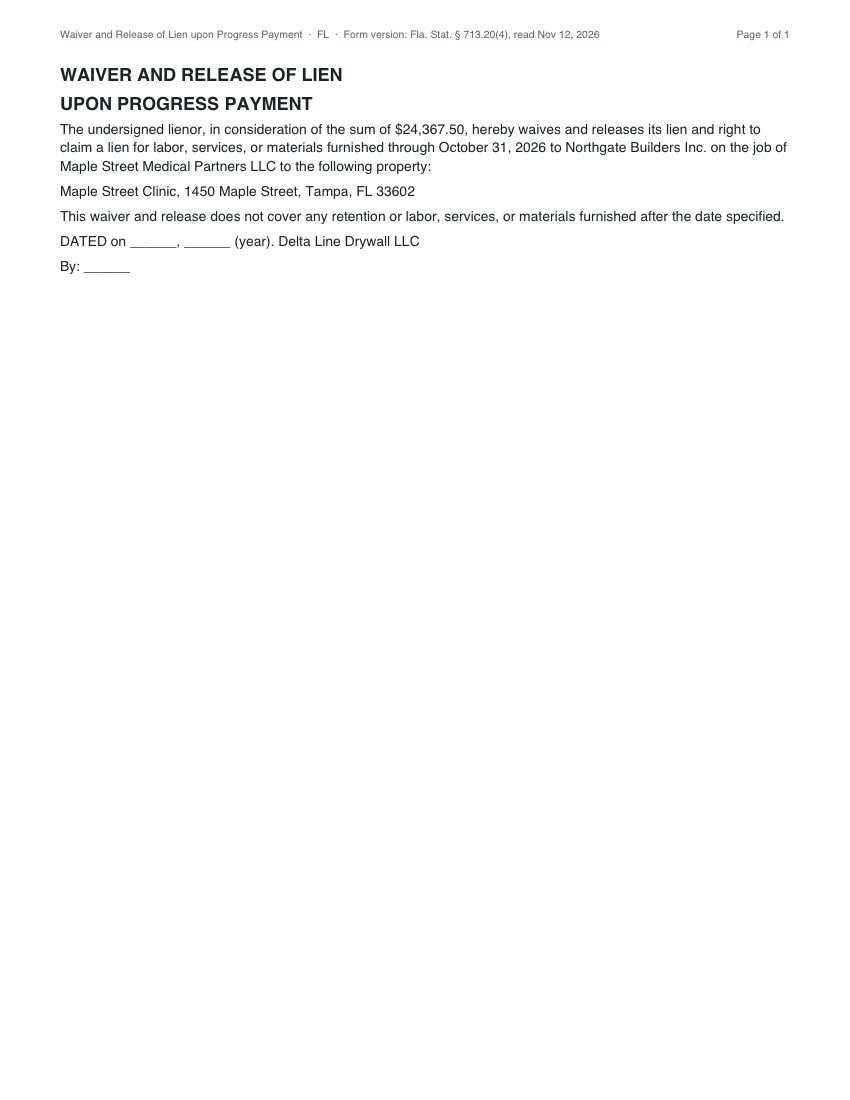
Not every State uses these four names. Florida’s two forms are titled Waiver and Release of Lien upon Progress Payment
and Waiver and Release of Lien upon Final Payment
. Georgia and Mississippi print an interim form, a final form and an affidavit of nonpayment. Utah prints a conditional progress form and a final one. In a State with no form of its own on this site, the app offers our general forms in the usual four kinds. The lien waiver guide lists every State page.
Terms in the sequence
| Term | What it is | How it is worked out |
|---|---|---|
| Current payment due | The payment a waiver names | The total earned less retainage, less what earlier pay apps asked for |
| Through date | The date a progress waiver runs through | The period end date of the pay app it is made from |
| Less previous applications | What earlier pay apps asked for | The sum of the payment due on each earlier finished pay app |
| Net change by change orders | How far the contract has moved from its original sum | Added change orders, less deducted ones |
| Retainage held | The share kept back, not named by a progress waiver | The rate times each line’s work, rounded on the line, then added |
Where a waiver and a pay app come apart
| The problem | What the app does |
|---|---|
| A conditional waiver for more than the payment due | Fills the amount from line 8 of the pay app it is made from |
| An unconditional waiver carrying the new pay app’s amount, not the one already paid | Fills an unconditional progress waiver from the pay app before it |
| A waiver for a pay app that is still a draft | Refuses until the pay app is finished |
| A through date that does not match the period | Fills it from the period end date of the pay app |
| Change orders added after the pay app was sent | Keeps a finished pay app frozen; a change makes a new version |
| Totals that do not carry forward | Carries earlier work and earlier payments from the last finished pay app |
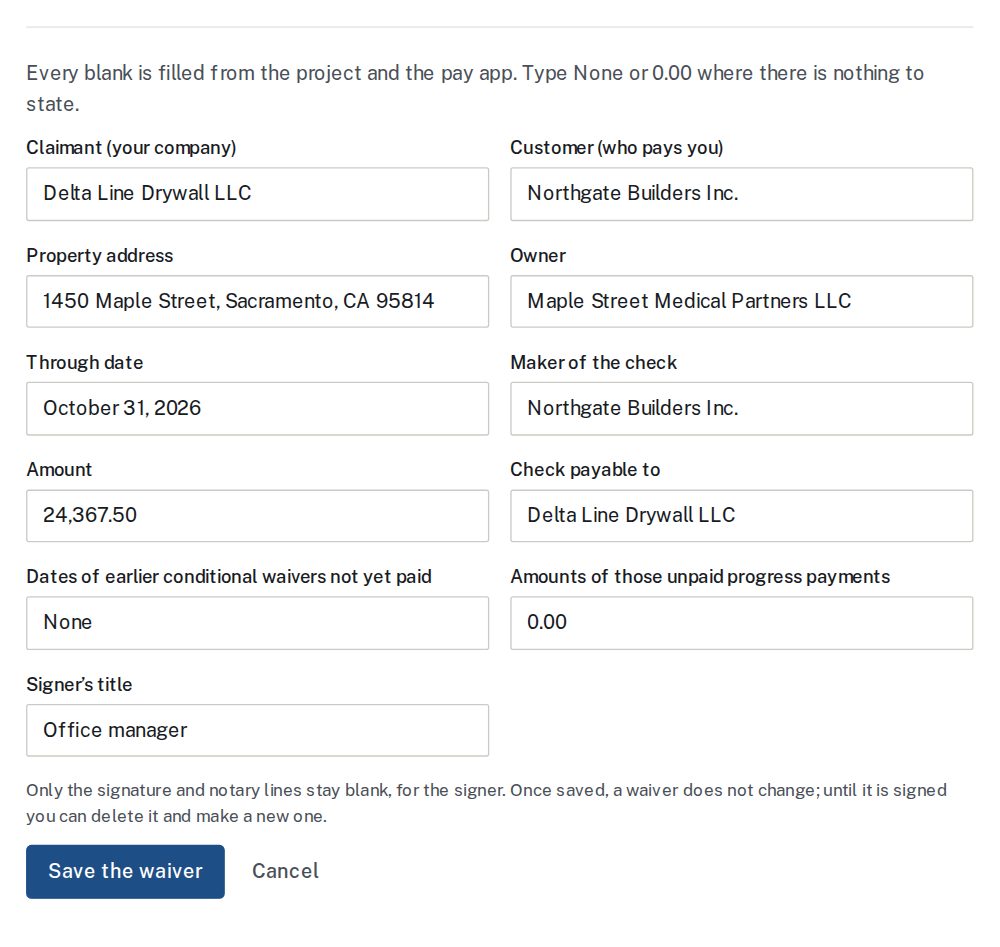
Making the sequence here
- Finish the pay app and make the conditional progress waiver from it.
- Sign the waiver typed or drawn, or send a signing link, and send it with the pay app as one PDF.
- When the payment clears, finish the next pay app and make the unconditional progress waiver from it. It opens with the earlier payment and date.
- Edit any blank that differs on the contract’s form, then save and sign.
- On the last pay app, make the conditional final waiver, and the unconditional final waiver once the final check has cleared.
Conditional and unconditional waiver questions
When does a conditional waiver take effect?
When the payment it names is received. California’s conditional progress form says it is effective only on the claimant’s receipt of payment from the financial institution the check is drawn on.
When does an unconditional waiver take effect?
When it is signed. California’s unconditional forms say in a notice that the document is enforceable against the signer who signs it, even if the signer has not been paid.
Which waiver goes with a pay app?
One common order is a conditional progress waiver sent with the pay app and the unconditional waiver for that payment signed once the check clears. The contract and the GC set the order on a given job.
Whose amount does an unconditional progress waiver carry in the app?
The pay app before the one it is made from, because that is the payment already received. Made from pay app 3, it opens with pay app 2’s payment due and period end date, and either blank can be edited.
What if the check for an earlier conditional waiver has not come?
California’s conditional progress form has an exception line for the dates and amounts of earlier conditional waivers that are still unpaid. The unconditional progress form has no such line.
Does a progress waiver cover retainage?
California’s progress forms list retentions first among the things the document does not affect. The retainage held after each pay app stays outside the progress waivers.
Are there conditional and unconditional forms for the final payment?
Yes, in the four usual kinds. In California the final forms carry a line for disputed claims for extras instead of the exceptions list of the progress forms.
Does every State use the names conditional and unconditional?
No. Twelve States print their own wording in a statute, and some title their forms differently: Florida upon progress and final payment, Georgia and Mississippi interim and final. Other States get our general forms in the four usual kinds.
Sources: California Civil Code 8132, California Civil Code 8134.
Related guides
For the blanks on each form, see the lien waiver form guide. Each kind has a page of its own: the conditional progress waiver and the unconditional final waiver. The payment a waiver names is worked out in the pay application guide.
We print the statute’s words and fill the blanks; we do not say which waiver to sign.