 Simple Pay Application
Conditional waiver and release on progress payment, explained
A conditional waiver and release on progress payment gives up lien and payment bond rights for work through a stated date, but only once the payment it names has actually been received. It is the waiver a sub signs while the check is still on its way, usually sent with the pay app.
Its twin, the unconditional progress waiver, takes effect when it is signed. The conditional one is the form a sub can send while the money is still on its way: in California’s wording it is effective only on receipt of the payment it names. In the app it is made from the same pay application as the payment it covers.
What the waiver says, in plain terms
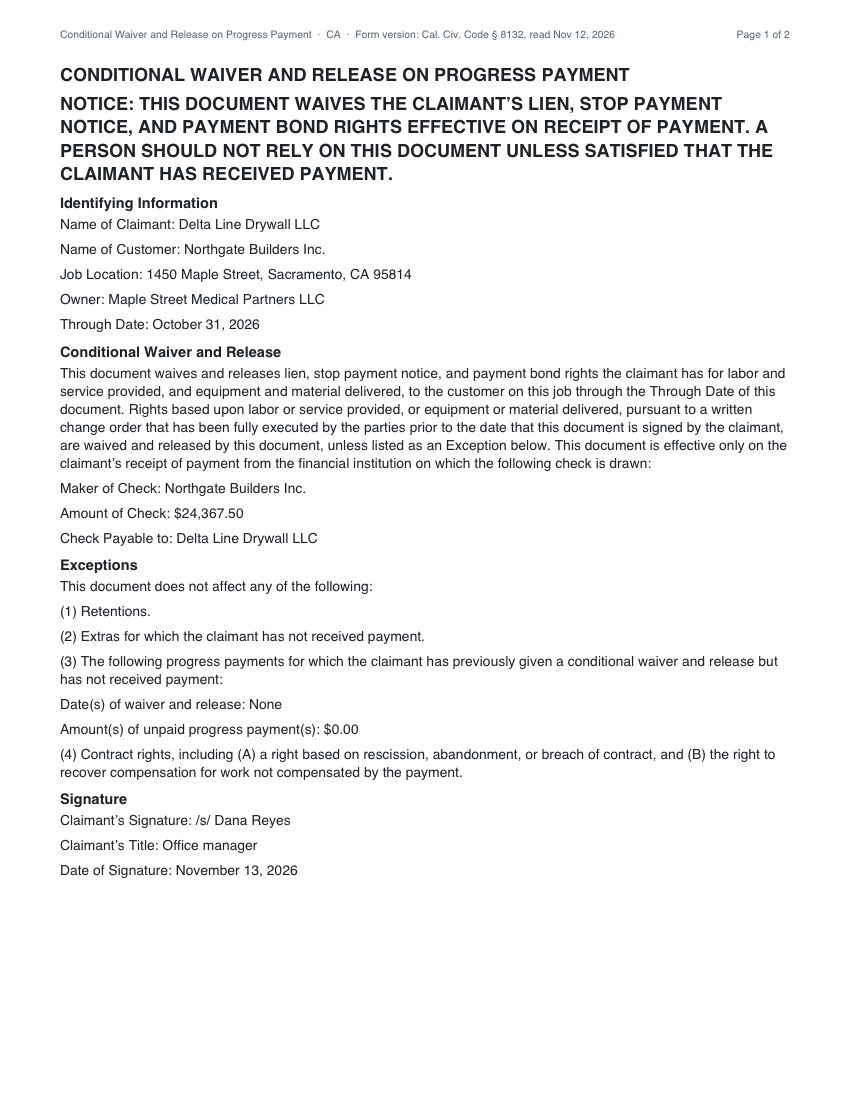
Every conditional progress waiver does three things. It names the job and the parties: the claimant signing it, the customer who pays, the owner and the job location. It says what is released: the claimant’s rights for labor, service, equipment and material on that job up to the Through Date. And it says when the release starts: on receipt of a named payment, not before.
California puts that last condition this way: This document is effective only on the claimant’s receipt of payment from the financial institution on which the following check is drawn
. Below that sentence come the maker of the check, its amount and the payee.
What the form leaves out matters as much. California’s version lists four exceptions it does not affect: retentions, extras not yet paid, earlier progress payments covered by a conditional waiver but not yet received, and contract rights. Work after the Through Date is outside the waiver altogether.
Which States print a form for it
Twelve States have waiver forms in their statutes that the app prints word for word. Six of them have a form by this name or close to it. The other six use different kinds, so the table shows each State’s nearest form and the note its statute file carries. The last two columns are the facts as we read them in each statute.
| State | Its form for a progress payment | Section | Use of the form | Notary |
|---|---|---|---|---|
| Arizona | Conditional Waiver and Release on Progress Payment | A.R.S. § 33-1008(D)(1) | Yes: a waiver is to be substantially in the statute’s form. | The statute is silent. |
| California | Conditional Waiver and Release on Progress Payment | Cal. Civ. Code § 8132 | Yes: a waiver is unenforceable unless it is in substantially the statute’s form (8132-8138). | The statute is silent. |
| Florida | Waiver and Release of Lien upon Progress Payment (a different kind) | Fla. Stat. § 713.20(4) | No: the statute gives forms a waiver may follow, and no one may require a different form (713.20(6)). The statute’s two forms are for progress and final payments; it does not call them conditional or unconditional. | The statute is silent. |
| Georgia | Waiver and Release of Lien and Payment Bond Rights upon Interim Payment (a different kind) | O.C.G.A. § 44-14-366 (d) | Yes: a waiver is enforceable only on a form that substantially follows the statute’s language, and only once payment is made as the statute sets out (44-14-366(c), (d), (e)). Under 44-14-366(g)(2) a waiver takes effect at the earliest of: receipt of the amount it states; a separate written acknowledgment of payment in full; or 90 days after it is signed, unless an affidavit of nonpayment is filed before then in the county where the property is located. The affidavit form is offered here. | The waiver forms have witness and address lines; the affidavit of nonpayment has a notary line. |
| Massachusetts | Partial Waiver and Subordination of Lien (a different kind) | M.G.L. c. 254 | The statute gives the form. | Signed under the penalties of perjury; the statute names no notary. |
| Michigan | Partial Conditional Waiver | MCL 570.1115(9)(b) | Yes: the forms are to be used in substantially the statute’s format. | The statute is silent. |
| Mississippi | Interim Waiver and Release upon Payment (a different kind) | Miss. Code § 85-7-433(1) | The section does not say. The notice on each form says a form without that notice is not enforceable as a waiver and release. The notice on each waiver form says the claimant is treated as paid in full the amount stated 60 days after the date stated on the form, unless an affidavit of nonpayment or a claim of lien is filed before then (85-7-433(1), (2)). The affidavit form is offered here. | Each waiver form and the affidavit of nonpayment carry a notary block. |
| Missouri | None for this kind | RSMo 429.016 (subsection 27) | Yes, for an unconditional final waiver on residential real property: it is valid only on a form substantially like the statute’s. The statute sets no form for the other kinds. | The statute is silent. |
| Nevada | Conditional Waiver and Release upon Progress Payment | NRS 108.2457 subsec. 5(a) | Yes: other forms are not enforceable. | The statute is silent. |
| Texas | Conditional Waiver and Release on Progress Payment | Tex. Prop. Code § 53.284(b) | Yes: a waiver is unenforceable unless it substantially complies with the statute’s form. | The statute is silent; it asks for the claimant’s or an authorized agent’s signature. |
| Utah | Conditional Waiver and Release upon Progress Payment | Utah Code § 38-1a-802(4)(b) | The statute gives forms a waiver may substantially follow. | The statute is silent. |
| Wyoming | Lien Waiver (a different kind) | W.S. 29-10-101(b) | The statute gives one form, to be substantially followed. One form for progress and final payments alike. | The form has a notary acknowledgment block. |
Michigan calls it a Partial Conditional Waiver, and Nevada and Utah say “upon” where Arizona, California and Texas say “on”. Utah’s statute has conditional forms only, so its unconditional ones come from our general set. In States without a statutory form, the app offers our general conditional progress waiver, written in the same order as the forms above.
The blanks, and where the app fills them from
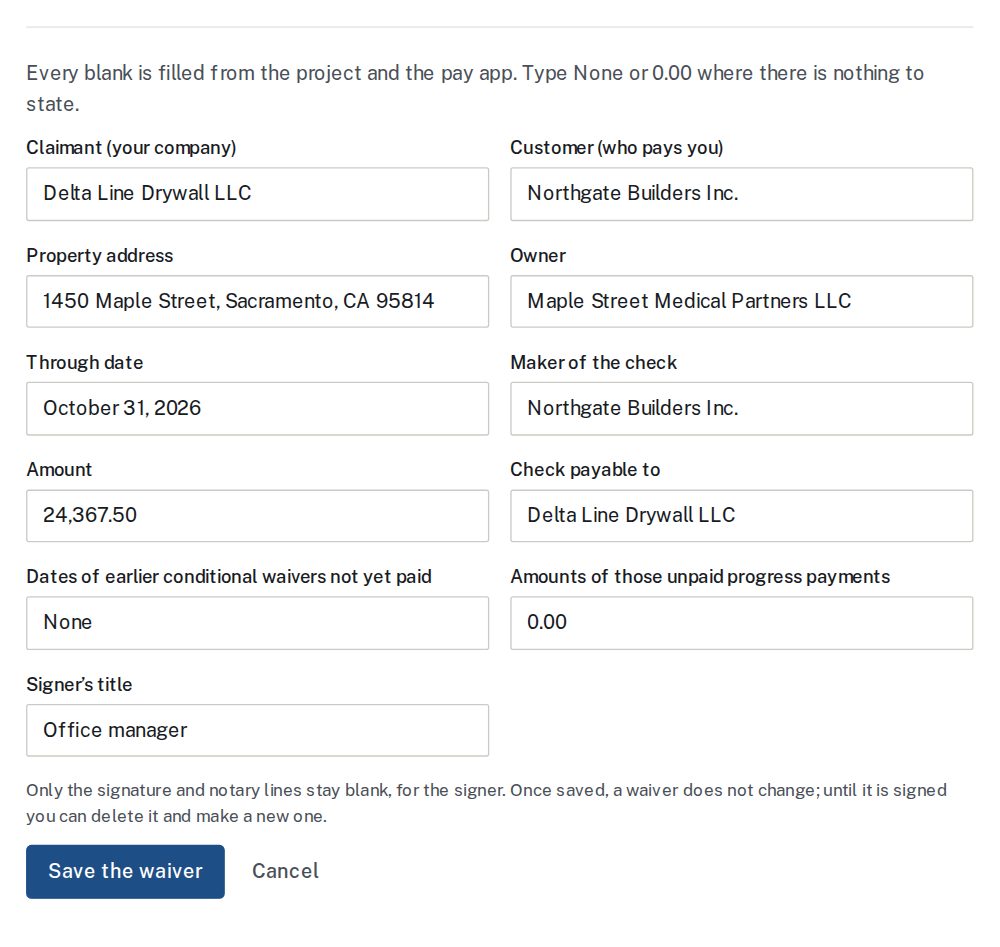
A conditional progress waiver has two groups of blanks: who and where, then the payment. In the app, none of them is typed twice.
- Name of Claimant. Your company, as set on the account.
- Name of Customer. The party you bill on the project, usually the GC.
- Job Location and Owner. From the project.
- Through Date. The period end date of the pay app the payment is for.
- Maker of Check. The customer, which you can change when a joint check or a lender pays.
- Amount of Check. The pay app’s current payment due, to the cent.
- Check Payable to. Your company.
- Exceptions. Any unpaid earlier conditional waivers, with their dates and amounts.
Then the signature block: the signer’s name, title and the date, typed or drawn in the app or by a signing link sent to the person who signs.
Conditional against unconditional, side by side
The two progress forms are near copies. The differences sit in four places, shown here with California’s pair (Civil Code 8132 and 8134) as the model.
| Point | Conditional progress | Unconditional progress |
|---|---|---|
| Takes effect | When the named payment is received from the bank it is drawn on | When signed; its notice says it binds the signer even if not paid |
| Payment lines | Maker of the check, its amount and the payee | One line: the progress payment received |
| Notice at the top | To the reader: do not rely on it until the claimant is paid | To the claimant, in type at least as large as anything else on the form |
| Exceptions | Four, including earlier conditional waivers still unpaid | Three, with no line for earlier unpaid waivers |
| Usual moment | With the pay app, before the money | After the check clears, often with the next pay app |
On many jobs the GC asks for both: a conditional waiver for this month’s payment, and an unconditional one for last month’s payment once it has cleared. The unconditional progress waiver page covers the twin, and conditional vs unconditional covers the timing across all four kinds.
A worked case: the waiver for pay app 3
A concrete sub on a $160,000 job bills its third pay app for the period to July 31, 2026. Two change orders have been signed by both parties: a $12,500 thickened slab at the loading dock, and a $4,000 credit for an east curb that was deleted. The contract sum to date is $168,500.
| Total completed and stored to date | $164,500.00 |
| Retainage at 10% | $16,450.00 |
| Total earned less retainage | $148,050.00 |
| Less previous applications | $113,625.00 |
| Current payment due | $34,425.00 |
The conditional progress waiver for this payment carries $34,425.00 as the amount of the check and July 31, 2026 as the Through Date. The $16,450 of retainage is not in that payment and stays outside the waiver as a retention.
Suppose the check for pay app 2, $48,825, has not arrived when this waiver is signed. On California’s form, that earlier waiver’s date and the $48,825 go on the exception line for unpaid progress payments. The form lists those payments among the things the document does not affect
. The retainage guide follows the same kind of job to the release at the end.
Questions about conditional progress waivers
When does a conditional progress waiver go out?
Usually with the pay app, or when the GC asks for one before releasing a check. In California’s wording it takes effect only once the payment it names is received from the bank the check is drawn on.
Does it cover retainage?
California’s form lists retentions first among the things it does not affect. On other States’ forms, the exceptions printed on the form say what is left out.
What if the check for the last waiver has not arrived?
California’s conditional progress form has a line for exactly that: the dates of earlier conditional waivers still unpaid and their amounts. The app keeps a list of your waivers with their pay apps, so the dates and amounts are at hand.
Can the GC ask for an unconditional waiver instead?
The GC and the contract set the order. California’s unconditional form carries its own notice that a claimant who has not been paid is to use the conditional form.
Is a notary needed?
It depends on the State. The table above shows what each statute says about a notary, from our reading of it.
Is the conditional progress waiver the same in every State?
No. Six States on this page print a conditional progress form with their own blanks and wording, six print a different set of forms, and in States without a page here the app offers our general form.
Sources: California Civil Code 8132, Texas Property Code 53.284.
Related pages
The lien waiver guide sets out all four kinds, and the California page prints this form in full with the statute’s other rules. For the final payment, see the conditional final waiver. The waiver’s amount comes from the pay application.
We print each State’s wording and the facts as read; we do not say which waiver to sign.