 Simple Pay Application
Unconditional waiver and release on progress payment, explained
An unconditional waiver and release on progress payment gives up lien, stop payment notice and payment bond rights for work through a stated date, and it takes effect when the claimant signs it. It states that the progress payment has already been received, and California’s notice on the form ends: IF YOU HAVE NOT BEEN PAID, USE A CONDITIONAL WAIVER AND RELEASE FORM.
The conditional waiver is the one that goes out while the money is still on its way. The unconditional one comes later, often in the same envelope as the next pay app, and closes the books on a payment that has arrived. In the app it is made from the finished pay app that the payment was for, so the amount on the waiver and the payment due on the pay app are the same number.
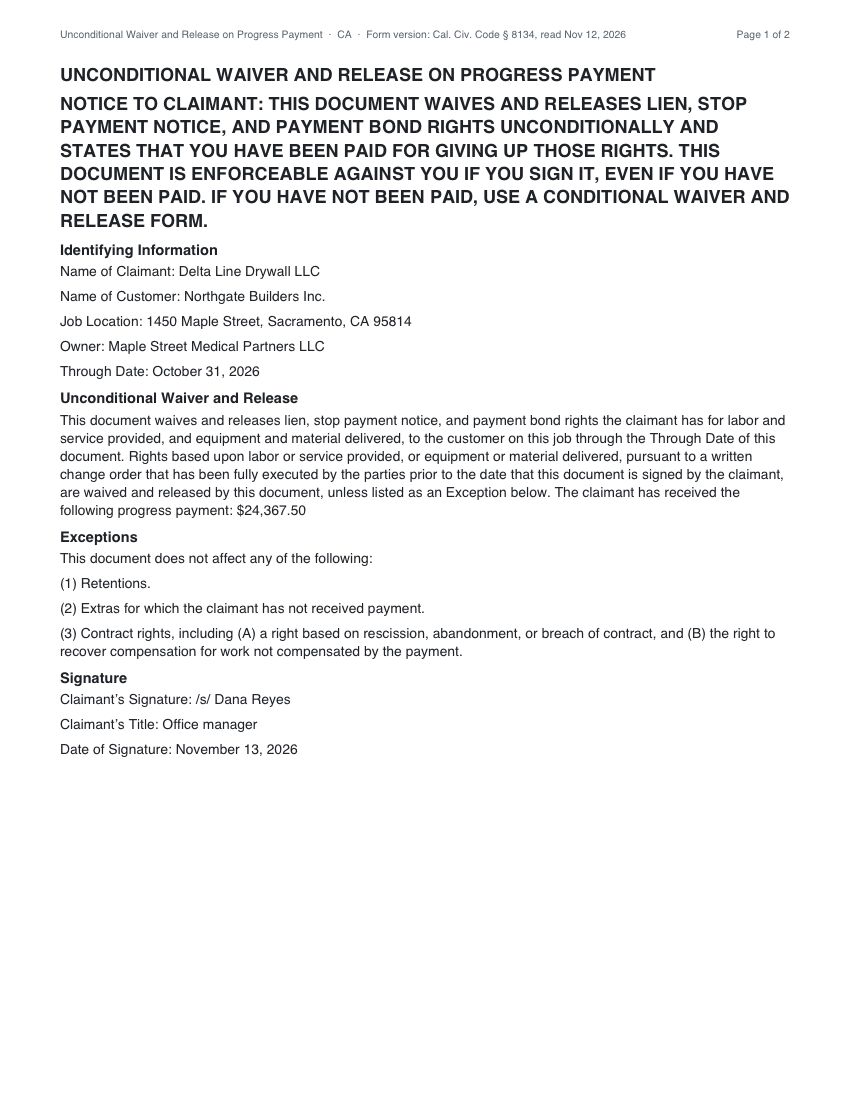
What the waiver says
An unconditional progress waiver does four jobs. It names the claimant who signs, the customer who pays, the job location and the owner. It releases the claimant’s rights for labor, service, equipment and material through the Through Date. It lists what the release leaves alone. And it records one fact: a stated progress payment has been received.
California’s wording for that last part is short: The claimant has received the following progress payment
, followed by the amount. The form names no check, no bank and no condition, so the release is in force from the day it is signed. Work under a written change order fully executed by the parties before that day is released with the rest, unless the change order is listed as an exception.
Three exceptions follow the release. The form says it does not affect retentions, extras for which the claimant has not received payment, or contract rights, including a right based on rescission, abandonment or breach of contract. Anything done after the Through Date sits outside the release as well. The retainage held back on a pay app is not part of the amount on the form, and the form lists retentions first among the things it does not affect.
The notice at the top
Above the blanks, California prints a notice addressed to the claimant, in capitals. It says the document is enforceable against the signer even if the signer has not been paid, and it ends by pointing an unpaid claimant to the other form: IF YOU HAVE NOT BEEN PAID, USE A CONDITIONAL WAIVER AND RELEASE FORM.
California’s section sets a type-size rule for it, at least as large as the largest type otherwise on the form. The sample picture shows the notice in large capitals, set apart from the body of the waiver.
Nevada’s statute carries a similar type-size line, printed above its own notice. Texas opens with a notice of its own, which says it is prohibited for a person to require the signer to sign the document if the signer has not been paid the payment amount. A sub reading any of these forms can see the same idea: the waiver is about money already in hand.
Which States print a form for it
Twelve States have waiver wording in their statutes, and the app prints that wording word for word. Six of them have an unconditional progress form under this name or close to it. The other six arrange their forms differently, so the table gives each State’s nearest form, where it has one, and marks it as a different kind. The last two columns repeat the facts as we read them in each statute.
| State | Its form for an unconditional progress payment | Section | Use of the form | Notary |
|---|---|---|---|---|
| Arizona | Unconditional Waiver and Release on Progress Payment | A.R.S. § 33-1008(D)(2) | Yes: a waiver is to be substantially in the statute’s form. | The statute is silent. |
| California | Unconditional Waiver and Release on Progress Payment | Cal. Civ. Code § 8134 | Yes: a waiver is unenforceable unless it is in substantially the statute’s form (8132-8138). | The statute is silent. |
| Florida | Waiver and Release of Lien upon Progress Payment | Fla. Stat. § 713.20(4) | No: the statute gives forms a waiver may follow, and no one may require a different form (713.20(6)). | The statute is silent. |
| Georgia | Waiver and Release of Lien and Payment Bond Rights upon Interim Payment (a different kind) | O.C.G.A. § 44-14-366 (d) | Yes: a waiver is enforceable only on a form that substantially follows the statute’s language, and only once payment is made as the statute sets out (44-14-366(c), (d), (e)). Under 44-14-366(g)(2) a waiver takes effect at the earliest of: receipt of the amount it states; a separate written acknowledgment of payment in full; or 90 days after it is signed, unless an affidavit of nonpayment is filed before then in the county where the property is located. The affidavit form is offered here. | The waiver forms have witness and address lines; the affidavit of nonpayment has a notary line. |
| Massachusetts | Partial Waiver and Subordination of Lien (a different kind) | M.G.L. c. 254 | The statute gives the form. | Signed under the penalties of perjury; the statute names no notary. |
| Michigan | Partial Unconditional Waiver | MCL 570.1115(9)(a) | Yes: the forms are to be used in substantially the statute’s format. | The statute is silent. |
| Mississippi | Interim Waiver and Release upon Payment (a different kind) | Miss. Code § 85-7-433(1) | The section does not say. The notice on each form says a form without that notice is not enforceable as a waiver and release. The notice on each waiver form says the claimant is treated as paid in full the amount stated 60 days after the date stated on the form, unless an affidavit of nonpayment or a claim of lien is filed before then (85-7-433(1), (2)). The affidavit form is offered here. | Each waiver form and the affidavit of nonpayment carry a notary block. |
| Missouri | None for this kind | RSMo 429.016 (subsection 27) | Yes, for an unconditional final waiver on residential real property: it is valid only on a form substantially like the statute’s. The statute sets no form for the other kinds. | The statute is silent. |
| Nevada | Unconditional Waiver and Release upon Progress Payment | NRS 108.2457 subsec. 5(b) | Yes: other forms are not enforceable. | The statute is silent. |
| Texas | Unconditional Waiver and Release on Progress Payment | Tex. Prop. Code § 53.284(c) | Yes: a waiver is unenforceable unless it substantially complies with the statute’s form. | The statute is silent; it asks for the claimant’s or an authorized agent’s signature. |
| Utah | Conditional Waiver and Release upon Progress Payment (a different kind) | Utah Code § 38-1a-802(4)(b) | The statute gives forms a waiver may substantially follow. The statute has no unconditional forms; our general forms are offered for those. | The statute is silent. |
| Wyoming | Lien Waiver (a different kind) | W.S. 29-10-101(b) | The statute gives one form, to be substantially followed. One form for progress and final payments alike. | The form has a notary acknowledgment block. |
Arizona, California, Florida, Michigan, Nevada and Texas each print a form of this kind. Michigan calls its form a Partial Unconditional Waiver, and Florida’s statute names its forms for progress and final payments without using the words conditional or unconditional. Nevada’s form has a line for the invoice or payment application number, and the Arizona, Nevada and Texas forms each add a sentence in which the signer says the money will go to the people who supplied labor, materials or equipment. California’s form has no such sentence.
Georgia and Mississippi print one interim form each in place of a pair, and the notice on each carries a time limit, 90 days in Georgia and 60 in Mississippi. Massachusetts has a partial waiver and subordination form, and Wyoming has a single form for progress and final payments alike. Utah’s statute has conditional forms only, and Missouri’s statute sets a form for the unconditional final waiver and no other kind. In States without a statutory form, the app offers our general unconditional progress waiver, in the same order as California’s.
The blanks, and where the app fills them from
Each blank below is taken from the account, the project or the pay app the waiver goes with, and the table shows what the sample picture carries for them.
| Blank | In the sample | Where it comes from |
|---|---|---|
| Name of Claimant | Delta Line Drywall LLC | The company set on the account |
| Name of Customer | Northgate Builders Inc. | The party billed on the project, usually the GC |
| Job Location | 1450 Maple Street, Sacramento, CA 95814 | The project |
| Owner | Maple Street Medical Partners LLC | The project |
| Through Date | October 31, 2026 | The period end date of the pay app the payment was for |
| Progress payment received | $24,367.50 | The pay app’s current payment due, to the cent |
| Signature, title, date | /s/ Dana Reyes, Office manager | Typed or drawn in the app, or signed from a link sent to the signer |
The three exceptions are printed as California gives them, so they have no blanks. This form also has no line for earlier conditional waivers that are still unpaid, which the conditional progress form does have. The progress payment is the one figure on the form, and it is copied from the pay app rather than typed a second time.
Unconditional against conditional, side by side
The two progress forms read alike, and the differences sit in a few places. California’s pair, Civil Code 8134 and 8132, shows them best.
| Point | Unconditional progress | Conditional progress |
|---|---|---|
| Takes effect | When the claimant signs it | On the claimant’s receipt of payment from the bank the named check is drawn on |
| What it says about payment | The claimant has received a progress payment, with one amount line | A check is coming, with lines for its maker, its amount and its payee |
| Notice at the top | To the claimant: enforceable if signed, even if unpaid | To the reader: be satisfied that the claimant has received payment before relying on it |
| Type-size rule | The notice at least as large as the largest type on the form | None stated in the section |
| Exceptions | Three | Four, the extra one for earlier unpaid conditional waivers |
| Usual moment | After the money has arrived | With the pay app, before the money |
GCs often ask for both on one job: a conditional waiver for this month’s request and an unconditional one for last month’s payment. The conditional progress waiver page covers the twin in the same layout, and conditional vs unconditional compares the timing of all four kinds.
A worked case: the waiver for pay app 1, sent with pay app 2
A drywall sub has a $120,000 contract with no change orders and 10% retainage. Pay app 1, for the period to January 31, 2026, bills $5,000 for mobilization, $16,800 of the $42,000 framing line and $3,850 of the $38,500 hanging line.
| Total completed and stored to date | $25,650.00 |
| Retainage at 10% | $2,565.00 |
| Total earned less retainage | $23,085.00 |
| Less previous applications | $0.00 |
| Current payment due | $23,085.00 |
The GC pays $23,085.00. When the check has cleared, the sub signs the unconditional progress waiver for it, with $23,085.00 as the progress payment received and January 31, 2026 as the Through Date. The $2,565.00 of retainage was never part of that payment, so it stays outside the waiver as a retention.
The waiver goes out with pay app 2, for the period to February 28, 2026. That pay app bills the job to $76,000.00, holds $7,600.00 as retainage, and takes off the $23,085.00 already paid.
| Total completed and stored to date | $76,000.00 |
| Retainage at 10% | $7,600.00 |
| Total earned less retainage | $68,400.00 |
| Less previous applications | $23,085.00 |
| Current payment due | $45,315.00 |
So the package for month two holds three papers: pay app 2 asking for $45,315.00, a conditional waiver for that amount through February 28, 2026, and the unconditional waiver for the $23,085.00 that month one has already brought in. The retainage guide follows the same drywall job as its retainage is released.
Questions about unconditional progress waivers
When is an unconditional progress waiver signed?
After the payment it names has arrived. California’s form says the claimant has received the progress payment, and its notice sends a claimant who has not been paid to the conditional form instead.
Does it cover retainage?
California’s form lists retentions first among the things it does not affect. Florida’s says it does not cover any retention, Arizona’s says the same, and Texas’s leaves out unpaid retention.
What date goes in the Through Date?
The period end date of the pay app the payment was for. For pay app 1 on the drywall job above, that is January 31, 2026.
Does the form have a line for earlier waivers that are still unpaid?
California’s unconditional progress form has none. Its conditional progress form has a line for the dates and amounts of earlier conditional waivers with payment not yet received.
Is a notary needed?
California’s sections are silent on a notary. The State table above shows what each statute says; Mississippi’s forms and Wyoming’s form carry a notary block, and Georgia’s forms have witness and address lines.
What does Utah use for an unconditional progress waiver?
Utah’s statute has conditional forms only. For the unconditional kind the app offers our general form on a Utah project.
Sources: California Civil Code 8134, Texas Property Code 53.284.
Related pages
The lien waiver guide sets out all four kinds with the State pages. The California page prints this form in full along with the statute’s other rules. When the job ends, the unconditional final waiver closes it out, and the waiver’s amount always starts in the pay application.
Each State’s wording is printed as its statute gives it, and the figures are arithmetic from a pay app.