 Simple Pay Application
Unconditional waiver and release on final payment, explained
An unconditional waiver and release on final payment gives up lien, stop payment notice and payment bond rights for the whole job, and it states that the claimant has been paid in full. It takes effect when it is signed, and California’s notice on the form ends: IF YOU HAVE NOT BEEN PAID, USE A CONDITIONAL WAIVER AND RELEASE FORM.
California’s notice to the claimant says the document is enforceable against the signer even if the signer has not been paid. The conditional final waiver is the form that notice points to. In the app the unconditional one is made from the final pay app, with the names and the job filled from the project.
What the waiver says
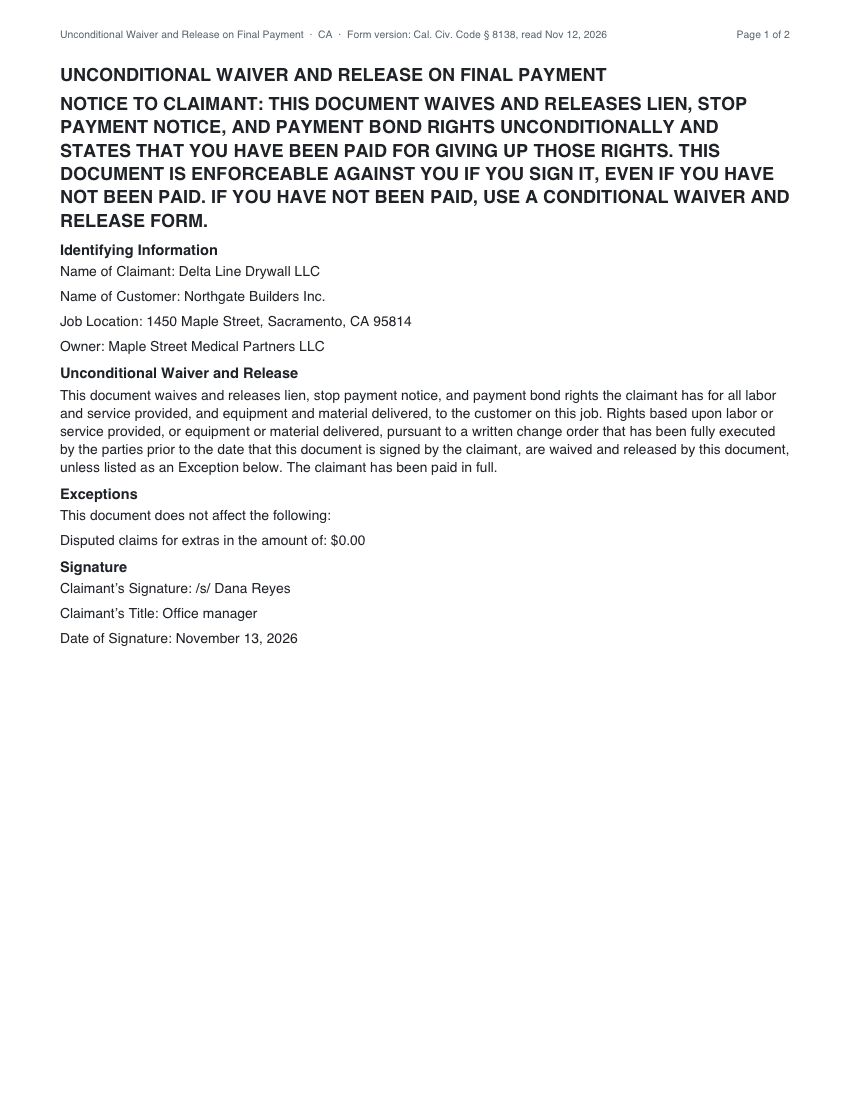
This is the shortest of California’s four forms. It names the claimant, the customer, the job location and the owner, then releases the claimant’s rights for all labor and service provided, and equipment and material delivered, to the customer on this job. The word all matters here: the form has no Through Date and no cut-off, so nothing on the job is left outside the release except what the exceptions line keeps.
On payment it says one sentence: The claimant has been paid in full.
The form carries no check, no bank and no amount, so the waiver does not restate how much was paid. The sums sit in the pay apps, and the waiver closes them out. Work under a written change order fully executed by the parties before the signing date is released too, unless the change order is listed as an exception.
The exceptions section holds a single line, Disputed claims for extras in the amount of
, with a dollar blank. California’s progress forms also list retentions and contract rights, and the final form lists neither. When nothing is in dispute the line stays open, as it does in the sample picture.
The notice at the top
The notice to the claimant is the same one the unconditional progress form carries. It says the document waives the rights unconditionally and states that the signer has been paid for giving them up, and that it is enforceable against the signer even if no payment has come. Its closing sentence sends an unpaid claimant to the other kind: IF YOU HAVE NOT BEEN PAID, USE A CONDITIONAL WAIVER AND RELEASE FORM.
California’s section also sets a type-size rule for the notice, at least as large as the largest type otherwise on the form. Nevada’s unconditional final form carries a line that says the same of its own notice, and Texas’s opens with a notice of its own about a person being prohibited from requiring the signature of someone who has not been paid. All three read as a warning to the person who signs.
Which States print a form for it
Twelve States have waiver wording in their statutes, and the app prints it word for word. Seven of them have an unconditional final form. The table lists those, and for the other five it shows the nearest form where there is one, marked as a different kind. The use and notary columns repeat the facts as we read them in each statute.
| State | Its form for an unconditional final payment | Section | Use of the form | Notary |
|---|---|---|---|---|
| Arizona | Unconditional Waiver and Release on Final Payment | A.R.S. § 33-1008(D)(4) | Yes: a waiver is to be substantially in the statute’s form. | The statute is silent. |
| California | Unconditional Waiver and Release on Final Payment | Cal. Civ. Code § 8138 | Yes: a waiver is unenforceable unless it is in substantially the statute’s form (8132-8138). | The statute is silent. |
| Florida | Waiver and Release of Lien upon Final Payment | Fla. Stat. § 713.20(5) | No: the statute gives forms a waiver may follow, and no one may require a different form (713.20(6)). | The statute is silent. |
| Georgia | Waiver and Release of Lien and Payment Bond Rights upon Final Payment (a different kind) | O.C.G.A. § 44-14-366 (e) | Yes: a waiver is enforceable only on a form that substantially follows the statute’s language, and only once payment is made as the statute sets out (44-14-366(c), (d), (e)). Under 44-14-366(g)(2) a waiver takes effect at the earliest of: receipt of the amount it states; a separate written acknowledgment of payment in full; or 90 days after it is signed, unless an affidavit of nonpayment is filed before then in the county where the property is located. The affidavit form is offered here. | The waiver forms have witness and address lines; the affidavit of nonpayment has a notary line. |
| Massachusetts | None for this kind | M.G.L. c. 254, s. 32(4) | The statute gives the form. | Signed under the penalties of perjury; the statute names no notary. |
| Michigan | Full Unconditional Waiver | MCL 570.1115(9)(c) | Yes: the forms are to be used in substantially the statute’s format. | The statute is silent. |
| Mississippi | Waiver and Release upon Final Payment (a different kind) | Miss. Code § 85-7-433(2) | The section does not say. The notice on each form says a form without that notice is not enforceable as a waiver and release. The notice on each waiver form says the claimant is treated as paid in full the amount stated 60 days after the date stated on the form, unless an affidavit of nonpayment or a claim of lien is filed before then (85-7-433(1), (2)). The affidavit form is offered here. | Each waiver form and the affidavit of nonpayment carry a notary block. |
| Missouri | Unconditional Final Lien Waiver for Residential Real Property | RSMo 429.016 subsection 27 | Yes, for an unconditional final waiver on residential real property: it is valid only on a form substantially like the statute’s. | The statute is silent. |
| Nevada | Unconditional Waiver and Release upon Final Payment | NRS 108.2457 subsec. 5(d) | Yes: other forms are not enforceable. | The statute is silent. |
| Texas | Unconditional Waiver and Release on Final Payment | Tex. Prop. Code § 53.284(e) | Yes: a waiver is unenforceable unless it substantially complies with the statute’s form. | The statute is silent; it asks for the claimant’s or an authorized agent’s signature. |
| Utah | Waiver and Release upon Final Payment (a different kind) | Utah Code § 38-1a-802(4)(c) | The statute gives forms a waiver may substantially follow. The statute has no unconditional forms; our general forms are offered for those. | The statute is silent. |
| Wyoming | Lien Waiver (a different kind) | W.S. 29-10-101(b) | The statute gives one form, to be substantially followed. One form for progress and final payments alike. | The form has a notary acknowledgment block. |
Arizona, California, Florida, Michigan, Missouri, Nevada and Texas print an unconditional final form. Arizona, Nevada and Texas use the words paid in full, and the same three add a sentence in which the signer says the money will go to the laborers, subcontractors, materialmen and suppliers on the job. Michigan’s Full Unconditional Waiver says the contract has been fully paid and satisfied. Florida’s is built around the final payment and its amount, and Nevada’s has a Payment Amount line and an Amount of Disputed Claims line.
Missouri is the odd one out. Its statute gives an unconditional final form for residential real property only, and the form releases any mechanic’s lien claim on that property without a payment sentence. Georgia and Mississippi print one final form each, with a notice that carries a time limit, 90 days in Georgia and 60 in Mississippi. Wyoming has one form for every payment, and Utah’s statute has conditional forms only. In States without a statutory form for this kind, the app offers our general unconditional final waiver.
The blanks, and where the app fills them from
Four blanks identify the job, one amount covers disputes, and the signature block closes the form. The sample picture shows them as follows.
| Blank | In the sample | Where it comes from |
|---|---|---|
| Name of Claimant | Delta Line Drywall LLC | The company set on the account |
| Name of Customer | Northgate Builders Inc. | The party billed on the project |
| Job Location | 1450 Maple Street, Sacramento, CA 95814 | The project |
| Owner | Maple Street Medical Partners LLC | The project |
| Disputed claims for extras | 0.00 | Typed on the waiver screen: the amount, or 0.00 when there is none |
| Signature, title, date | /s/ Dana Reyes, Office manager | Typed or drawn in the app, or signed from a link sent to the signer |
There is no amount to carry over from the pay app, since the form says paid in full and names no figure. The final pay app still matters: it is the record of what was billed and what was held, and the waiver is made from it, so the project and the parties on the two papers match.
Unconditional against conditional, side by side
The two final forms share their blanks for the parties and their one exception, so the comparison is short. California’s pair is Civil Code 8138 and 8136.
| Point | Unconditional final | Conditional final |
|---|---|---|
| Takes effect | When the claimant signs it | On the claimant’s receipt of payment from the bank the check is drawn on |
| Statement about payment | The claimant has been paid in full | A check is named, with its maker, amount and payee |
| Amount on the form | None, apart from disputed claims | Amount of Check, plus disputed claims |
| Notice at the top | To the claimant: enforceable if signed, even if unpaid | To the reader, about relying on it before payment is received |
| Type-size rule | The notice at least as large as the largest type on the form | None stated in the section |
| Usual moment | After the final check has cleared | With the final pay app, before the check |
The conditional final waiver page covers the first of the two papers in the same layout, and conditional vs unconditional sets all four kinds side by side.
A worked case: the waiver that closes a retainage release
A drywall sub has a $120,000 contract, no change orders and 10% retainage. Pay apps 1 to 3 billed $108,000.00 between them, with every line at 100% by the third and $12,000 of retainage still held. Pay app 4, for the period to April 30, 2026, adds no new work and releases that $12,000.
| Total completed and stored to date | $120,000.00 |
| Total earned less retainage | $120,000.00 |
| Less previous applications | $108,000.00 |
| Current payment due | $12,000.00 |
| Balance to finish | $0.00 |
With pay app 4 the sub has billed the whole $120,000.00, and the balance to finish is $0.00. The conditional final waiver for the $12,000.00 went out with that pay app. Once the check clears, the sub signs the unconditional final waiver, and the paperwork on the job is complete.
The form itself carries no dollar figure from this job: the parties and the location are filled from the project, and the disputed claims line reads 0.00 because no extra here is in dispute. The figures live in the pay apps. If a sub does hold a disputed extra, the amount goes on that line, as the form allows. The retainage guide shows how the $12,000.00 built up line by line.
Questions about unconditional final waivers
When does an unconditional final waiver take effect?
When it is signed. California’s notice says the document is enforceable against the signer even if the signer has not been paid, and it sends an unpaid claimant to the conditional form.
Does the form show a Through Date or an amount?
California’s does neither. Nevada’s form has a Payment Amount line, Florida’s names the final payment and its amount, and Arizona’s has no amount line.
What is the disputed claims line for?
It holds the amount of any disputed claims for extras that the form does not affect. California, Arizona and Nevada print it; Texas’s, Florida’s and Michigan’s unconditional final forms do not.
Does the form cover retainage?
It releases the claimant’s rights for all labor, service, equipment and material on the job, and California’s final form has no line for retentions. The worked case bills the retainage release on the final pay app, so the payment due and the retainage are both $12,000.00.
Is a notary needed?
California’s sections are silent on a notary. The State table above shows each statute’s position: Mississippi’s final form and Wyoming’s form carry a notary block, and Georgia’s has witness and address lines.
Does every State have an unconditional final form?
No. Utah’s statute has conditional forms only, Massachusetts has a single partial waiver and subordination form, and Missouri’s statute sets an unconditional final form for residential real property only.
Sources: California Civil Code 8138, Texas Property Code 53.284.
Related pages
The lien waiver guide lays out all four kinds with the State pages, and the California page prints this form in full next to the statute’s other rules. For the months before the end of a job, see the unconditional progress waiver. The job’s billing history sits in the pay application.
If the last check is the retainage held over the job, retainage release walks through the pay app that bills it.
Each form is printed in the words of its State’s statute, and the money figures are arithmetic from the pay apps.