 Simple Pay Application
G702 and G703, the two parts of a pay app
G702 and G703 are the payment application and the continuation sheet that AIA sells for progress billing. A G702/G703-style pay app carries the same two parts, a summary of the job and a sheet of line items, in its own layout.
GCs and owners know a pay app by these two form numbers, so subs ask what each one holds. This guide sets out what AIA’s own pages say about each form, shows the summary and the sheet of our pay app beside them, and works one roofing job through every line to the cent.
What AIA says the G702 holds
AIA’s page for the G703, read Nov 13, 2026, lists the G702 beside it as the Payment Application and Certificate for Payment. AIA Contract Documents’ article AIA Billing Explained, read the same day, describes the G702 as the form a contractor uses to submit its application for payment to the owner or to whoever issues the payments. The article names the details it includes: the billing period, the total contract value, the work completed to date and the amount being requested. It calls the G702 the formal request for payment and the first step in the billing process. It also says the application is certified by the contractor, and in some cases by the architect or project manager as well.
This guide takes no more than that from AIA about the G702 itself. The rest of the page describes our own G702/G703-style pay app, which carries those details in a layout of its own.
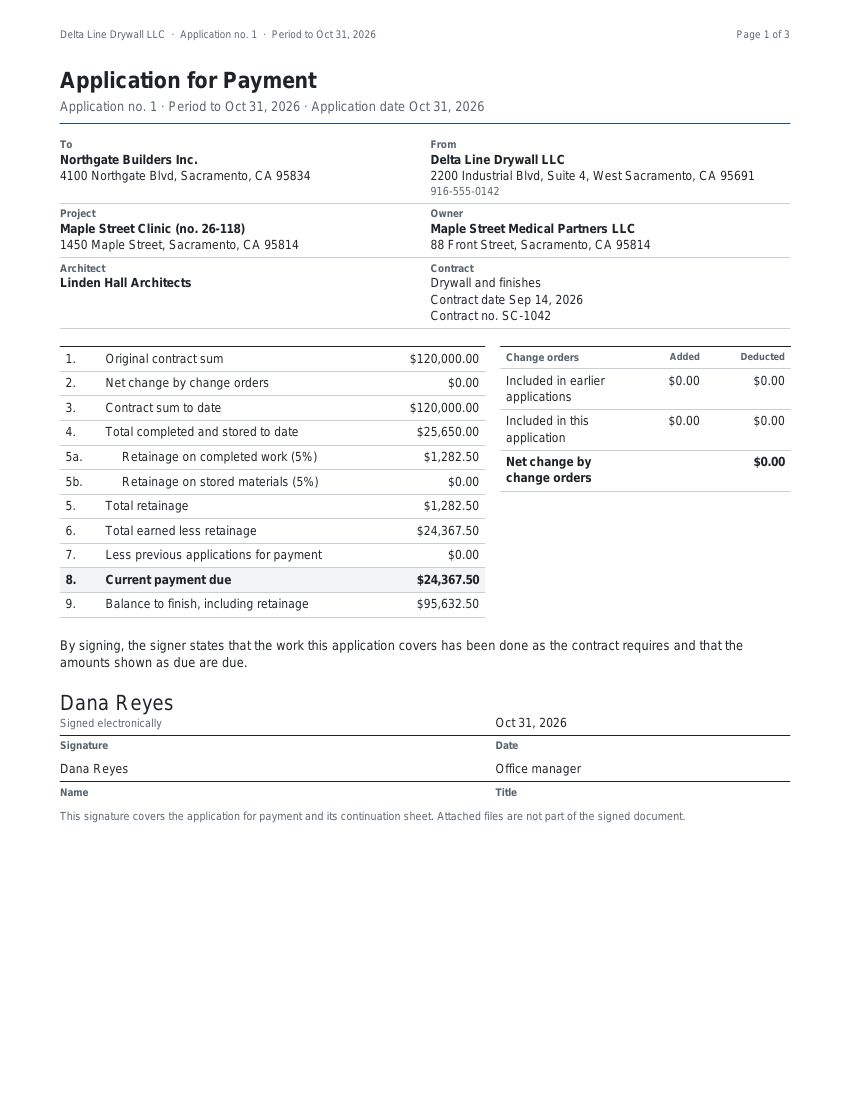
Our summary page fits on one page. The top block names the GC it goes to, the sub it comes from, the project, the owner, the architect where there is one, and the contract, with the application number and the period it runs to. Below that sit nine numbered lines, in this order:
- The original contract sum.
- The net change by change orders.
- The contract sum to date, which is the first two lines added.
- The total completed and stored to date, which is the grand total from the continuation sheet.
- The retainage, split into the part held on completed work and the part held on stored material.
- The total earned less retainage.
- The previous applications for payment.
- The current payment due.
- The balance to finish, including retainage.
Change orders signed by both parties show on the summary as additions and deductions. Below the lines, the sub signs a statement that the work the application covers has been done as the contract requires and that the amounts shown as due are due.
What AIA says the G703 holds
The same article describes the G703 Continuation Sheet as the form that goes with the G702 and gives a detailed breakdown of the work completed, the values that go with it, and any deductions or retainage. It names the schedule of values as the list that breaks the contract value into line items, the reference that progress is tracked against.
On our pay app that breakdown is the continuation sheet. It has one row for each line of the schedule of values, in the same order on every pay app of the job: the item number and a description of the work, the scheduled value, the work completed in earlier applications, the work completed this period, the materials presently stored, the total completed and stored to date, the percent complete, the balance to finish, and the retainage on that line.
The bottom row adds each figure down the page. Those totals are the numbers that go up to the summary: the total completed and stored becomes line 4, and the scheduled values add up to line 3. When a GC checks a pay app, most of the checking is this step: do the rows add across, do the totals match the summary, and do the earlier-work figures match what was billed last month. The continuation sheet guide goes through the sheet item by item.
How a G702/G703-style pay app lines up
AIA sells its documents, and G702 and G703 are its registered trademarks. Simple Pay Application draws its own layout and writes its own headings. It makes a G702/G703-style pay application with the same two parts, a summary and a continuation sheet. Every page of this site says in its footer that it is not an AIA Contract Document, and the PDFs carry that line too. The table takes each detail the article lists and shows where it sits on our pay app.
| What the article lists | Where it sits on our pay app |
|---|---|
| G702, the billing period | The period the application runs to, in the summary’s top block |
| G702, the total contract value | Line 1, the original contract sum, with change orders on line 2 and the contract sum to date on line 3 |
| G702, the work completed to date | Line 4, the total completed and stored, carried up from the bottom of the continuation sheet |
| G702, the amount being requested | Line 8, the current payment due |
| G703, the work completed and its values | One row per schedule of values line, with earlier work carried forward from the last finished pay app |
| G703, deductions or retainage | A deduction is a row with a negative value; retainage is a column, rounded on each line, whose total is line 5 |
| Certification by the contractor | The sub’s signature under a statement about the work and the amounts due |
Where a contract names AIA’s forms, the contract decides what the GC accepts. Many GCs take a pay app that has the same fields in the sub’s own layout, and some ask for their own template. That is a question for the sub and the GC. The AIA billing guide covers the method behind both forms: progress billing against a schedule of values.
A worked example: the second pay app on a roofing job
A roofing sub has a $120,000 contract. Its contract holds 10% retainage until the job is half done and nothing on work after that point. The first pay app took the job to exactly $60,000, half the contract, with $6,000 held. The second covers the period to March 31, 2026: the membrane goes on and the flashing starts. No materials are stored and there are no change orders.
| Line | Scheduled value | From earlier apps | This period | Stored | Total to date | % | Balance to finish | Retainage |
|---|---|---|---|---|---|---|---|---|
| 1 Tear-off | 30,000.00 | 30,000.00 | 0.00 | 0.00 | 30,000.00 | 100.00 | 0.00 | 3,000.00 |
| 2 Deck repair | 10,000.00 | 10,000.00 | 0.00 | 0.00 | 10,000.00 | 100.00 | 0.00 | 1,000.00 |
| 3 Membrane | 70,000.00 | 20,000.00 | 35,000.00 | 0.00 | 55,000.00 | 78.57 | 15,000.00 | 2,000.00 |
| 4 Flashing | 10,000.00 | 0.00 | 2,500.00 | 0.00 | 2,500.00 | 25.00 | 7,500.00 | 0.00 |
| Totals | 120,000.00 | 60,000.00 | 37,500.00 | 0.00 | 97,500.00 | 22,500.00 | 6,000.00 |
This table is the continuation sheet of the second pay app. Read across any row and the earlier work plus this period plus the stored materials gives the total to date. The membrane is 78.57% done because $55,000 is 78.57% of $70,000. Notice the retainage column: the membrane holds $2,000, which is 10% of the $20,000 billed before the halfway point, and nothing on this month’s $35,000. The flashing holds nothing at all.
| 1Original contract sum | $120,000.00 |
| 2Net change by change orders | $0.00 |
| 3Contract sum to date | $120,000.00 |
| 4Total completed and stored to date | $97,500.00 |
| 5Retainage held, all on work billed before the rate stopped | $6,000.00 |
| 6Total earned less retainage | $91,500.00 |
| 7Less previous applications | $54,000.00 |
| 8Current payment due | $37,500.00 |
| 9Balance to finish, including retainage | $28,500.00 |
This is the summary page of the same pay app. Line 4 is the bottom of the total-to-date column, $97,500. Line 5 is the bottom of the retainage column, $6,000, and the same as before the pay app: with a rate of zero on new work, nothing is added. Line 7 is $54,000, the first pay app’s $60,000 less its $6,000 retainage. So the payment due on line 8 is $37,500.00, exactly this month’s work. Line 9 equals the balance column, $22,500, plus the $6,000 still held, which is $28,500.
The terms on a G702/G703-style pay app, and the arithmetic behind each
| Term | Where our pay app puts it | How it is worked out |
|---|---|---|
| Original contract sum | Summary, line 1 | The contract price when signed, which the scheduled values on the continuation sheet add up to |
| Net change by change orders | Summary, line 2, with additions and deductions shown apart | Additions signed by both parties, less deductions |
| Contract sum to date | Summary, line 3 | The original contract sum plus the net change |
| Scheduled value | Continuation sheet, each row | The dollar value given to that line of the SOV |
| Work from earlier applications | Continuation sheet, each row | What that line earned on all earlier pay apps, carried forward |
| Work this period | Continuation sheet, each row | Typed in dollars, or a percent of the line’s value turned into dollars |
| Materials presently stored | Continuation sheet, each row | Stored last time, plus new deliveries, less what was installed this period |
| Total completed and stored to date | Continuation sheet, each row; summary, line 4 | Earlier work, plus this period, plus the stored materials; the lines are added for the summary |
| Percent complete | Continuation sheet, each row | The total to date divided by the scheduled value |
| Balance to finish | Continuation sheet, each row | The scheduled value less the total to date |
| Retainage | Summary, line 5; continuation sheet, each row | A rate times the work, and a rate times the stored materials, rounded on each line and then added |
| Total earned less retainage | Summary, line 6 | The total completed and stored, less the retainage held |
| Previous applications for payment | Summary, line 7 | The amounts earlier pay apps asked for, carried from the last finished pay app |
| Current payment due | Summary, line 8 | The total earned less retainage, less the previous applications |
| Balance to finish, including retainage | Summary, line 9 | The contract sum to date, less the total earned less retainage |
Why pay apps get kicked back, and what the app checks
A GC who sends a pay app back usually found a number that does not agree with another number on the pages. The table lists the usual ones and says what the app’s billing engine does about each before the pay app is finished.
| Reason it comes back | What the app does |
|---|---|
| Scheduled values that do not add up to the contract | Shows the difference and blocks finishing until the SOV total equals the contract sum to date |
| Earlier work that differs from last month’s sheet | Carries earlier work and earlier payments forward from the last finished pay app, so they are not retyped |
| Retainage that does not match the rows | Rounds each line, then adds the lines, so line 5 is the sum of the retainage column |
| Stored materials billed again when installed | Moves installed material from stored into work, and blocks installing more than was stored |
| A change order without its own row | Gives each change order signed by both parties its own row from the next pay app, and a negative row for a deduction |
| A line billed past its value | Warns and names the line; the pay app can still be finished |
| A correction that drops a line below zero | Blocks the pay app until the line is back at zero or above |
| A retainage release above what is held | Blocks the pay app and shows the amount held |
| A payment due below zero | Warns that the pay app would return money to the GC |
| The lien waiver or backup is missing | Makes the waiver from the finished pay app and puts it and the backup files in the same PDF |
The engine is tested against twelve worked jobs, each figured by hand to the cent. The roofing job above is one of them.
Retainage that stops, on the summary and the sheet
The roofing job shows the case that confuses people most: a retainage rate that changes partway through. On our summary, line 5 is the retainage held, in dollars. One percent of the total would not describe it, since the first $60,000 of work was held at 10% and the next $37,500 at 0%. That is why retainage is figured line by line and shown in its own part of the continuation sheet: the retainage column carries what was held on each line, and line 5 is its total.
In the app a rate change applies to later work only. Retainage already held stays as it was, which is why line 5 shows $6,000.00 on the second pay app, the same $6,000 the first one held. When the job ends, the release is entered on a pay app and cannot be more than what is held. The retainage guide works through a release with figures.
Making a G702/G703-style pay app here
- Paste the schedule of values from Excel or upload a CSV, and tie it to the contract sum.
- Enter this period's work on each line, in dollars or as a percent.
- Add materials stored on site, and move them into work as they are installed.
- Read retainage, previous applications and the payment due on the summary.
- Sign, attach the backup and the lien waiver, and send one PDF.
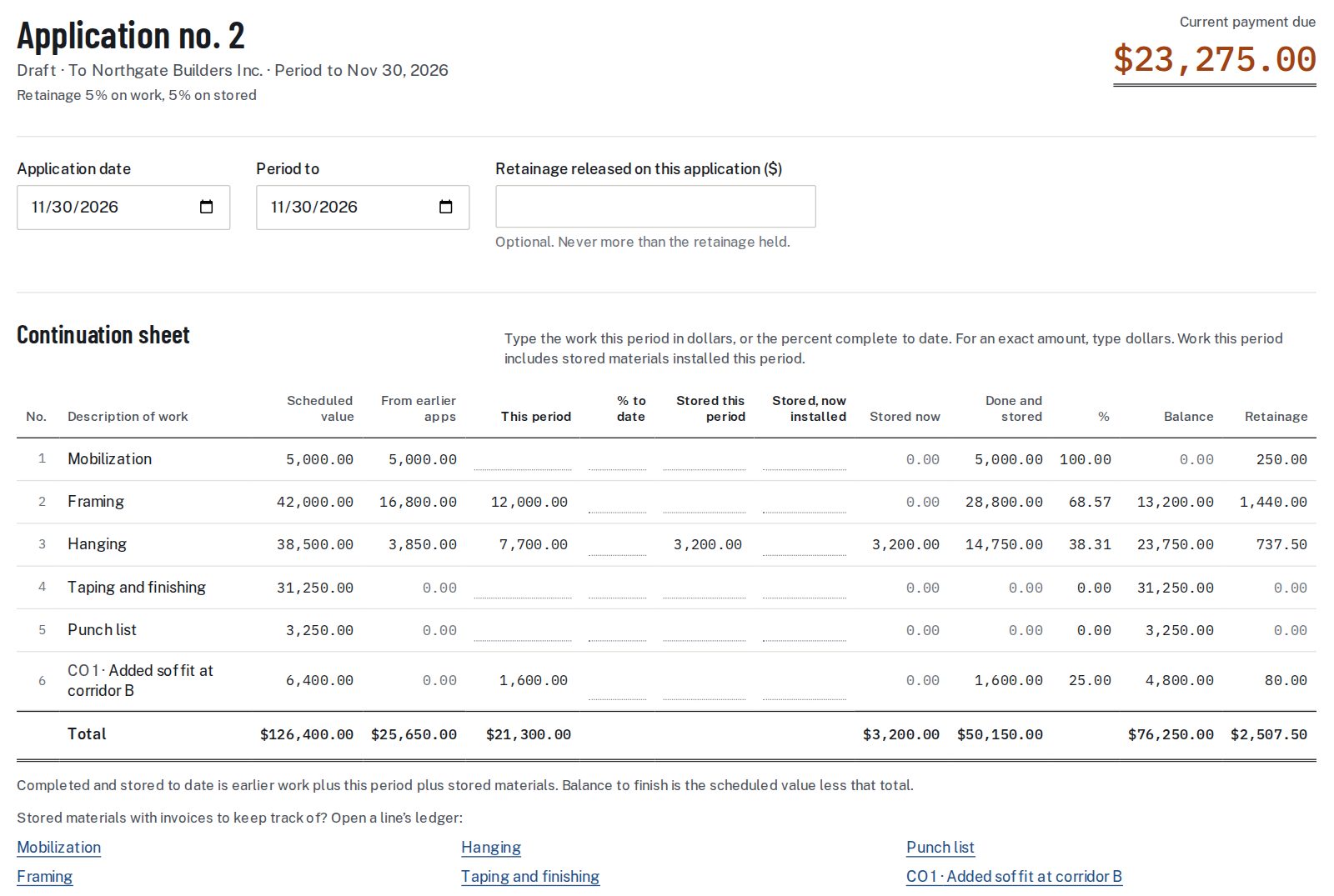
The screen is the continuation sheet and the summary at once. Typing this period’s work on a line moves line 4 to 9 of the summary at the same moment, so the sheet and the summary agree. The lien waiver for each payment is filled from the finished pay app, blank by blank, as the lien waiver form guide shows. The first pay app on a job takes longest, because the schedule of values goes in once; each later one starts from the last. The lien waiver for the payment is made from the finished pay app and goes into the same PDF.
G702 and G703 questions
Who publishes G702 and G703?
The American Institute of Architects (AIA). They are its documents and its registered trademarks, and AIA sells them.
What is the difference between the G702 and the G703?
AIA Contract Documents’ article on AIA billing, read Nov 13, 2026, calls the G702 the payment application, with the billing period, contract value, work completed to date and amount requested, and the G703 the continuation sheet that breaks the work down with its values and any retainage.
Is your pay app a G702?
No. It is a G702/G703-style pay app in our own layout, with the figures GCs look for in the same order. It is not an AIA document, and every page of the site says so in its footer.
Do I need AIA's own forms to bill this way?
The contract says which form to use. Many GCs take a pay app with the same fields in the sub's own layout, and some ask for their own template.
Which summary line is the amount I get paid?
Line 8 of our summary, the current payment due. It is the total earned less retainage, less what earlier pay apps asked for. On the roofing job above it is $37,500.00.
Where do the summary totals come from?
From the continuation sheet. The total completed and stored on line 4 is the bottom of the total-to-date figures, and the scheduled values add up to the contract sum to date on line 3.
Can I bring my schedule of values from Excel?
Yes. Paste the rows from Excel or upload a CSV file. The app reads the line numbers, descriptions and values, and shows how far the total is from the contract sum.
Why is line 7 not the work billed last month?
Line 7 is what earlier pay apps asked to be paid, after retainage. On the roofing job the first pay app billed $60,000, held $6,000, and asked for $54,000, so $54,000 is the figure on line 7.
Sources: FAR 52.232-5, Payments under Fixed-Price Construction Contracts, AIA Contract Documents, AIA Billing Explained (read Nov 13, 2026).
Related guides
For the whole document, read what a pay application is. The continuation sheet and schedule of values guides cover the G703 side, and AIA billing covers the method.
For software that prints these forms, or a layout of its own like ours, see G702 and G703 software; for the change order lines on the summary, see the change order form guide.