 Simple Pay Application
AIA billing in plain terms
AIA billing is progress billing against a schedule of values. Each period the sub bills the share of every line that is done, takes off retainage and what earlier pay apps asked for, and asks for the difference. AIA stands for the American Institute of Architects, and AIA-style billing means the method, whoever’s layout carries it.
Our pay app follows the method in a layout of our own. This guide walks through one billing period on an electrical job with stored materials, explains what AIA’s forms are and where ours differs, and lists what a GC checks before it pays.
How a billing period runs
Before the first bill, the sub and the GC agree a schedule of values (SOV) that adds up to the contract sum. Every line has a value, and the sub bills against those lines, never against the contract as a lump. At each cut-off the sub reports what was done on each line since the last pay app, and the pay app turns that into a payment due.
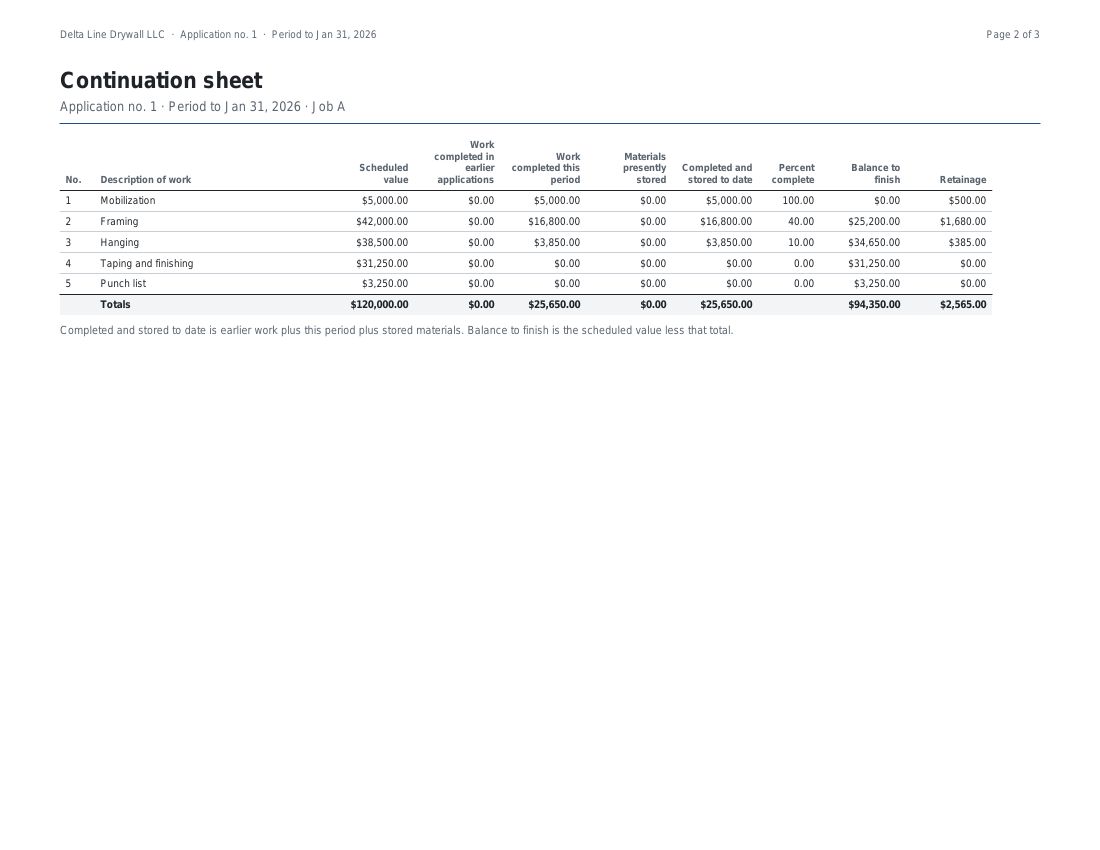
The method rests on carry-forward. Work to date on every line, retainage held and payments asked for all roll over from one pay app to the next, so a period’s billing comes down to the new work. A GC reading pay app 6 is reading the same job as pay app 5 with one more period added, and can check that by comparing the two.
A worked example: stored materials on an electrical job
An electrical sub has a $200,000 contract with retainage of 10% on work and 5% on stored materials. The first pay app, for the period to March 31, 2026, bills 30% of the rough-in labor and stores two deliveries on site: switchgear for $52,500.50 and fixtures for $12,000.00. Nothing is installed yet from either delivery.
| Line | Scheduled value | Work this period | Materials stored | Total to date | % | Balance to finish | Retainage |
|---|---|---|---|---|---|---|---|
| 1 Rough-in labor | 60,000.00 | 18,000.00 | 0.00 | 18,000.00 | 30.00 | 42,000.00 | 1,800.00 |
| 2 Switchgear | 85,000.00 | 0.00 | 52,500.50 | 52,500.50 | 61.77 | 32,499.50 | 2,625.03 |
| 3 Fixtures | 40,000.00 | 0.00 | 12,000.00 | 12,000.00 | 30.00 | 28,000.00 | 600.00 |
| 4 Trim-out | 15,000.00 | 0.00 | 0.00 | 0.00 | 0.00 | 15,000.00 | 0.00 |
| Totals | 200,000.00 | 18,000.00 | 64,500.50 | 82,500.50 | 117,499.50 | 5,025.03 |
| 1Original contract sum | $200,000.00 |
| 2Net change by change orders | $0.00 |
| 3Contract sum to date | $200,000.00 |
| 4Total completed and stored to date | $82,500.50 |
| 5Retainage held: $1,800.00 on work, $3,225.03 on stored materials | $5,025.03 |
| 6Total earned less retainage | $77,475.47 |
| 7Less previous applications | $0.00 |
| 8Current payment due | $77,475.47 |
| 9Balance to finish, including retainage | $122,524.53 |
The stored materials count as billed: switchgear shows 61.77% complete on a line that has had no installation. They carry retainage at the lower stored rate. On the switchgear, 5% of $52,500.50 is $2,625.025, and the line rounds it to $2,625.03. When the switchgear is installed, the dollars move from stored into work on the same line, and the retainage on them follows the work rate from then on. The retainage guide follows a rate change and a release.
What AIA’s forms are, and what ours is
AIA Contract Documents’ article AIA Billing Explained, read Nov 13, 2026, describes AIA billing as a standardized process for payment applications, built on two forms: a payment application and a continuation sheet. It says the payment application carries the billing period, the total contract value, the work completed to date and the amount requested, and the continuation sheet gives the detailed breakdown of the work, its values and any retainage. Most GCs and architects know the pair by AIA’s form numbers, and the guide to the two forms sets out what AIA says each one holds.
Our pay app is our own layout, built on the same method: a summary page of nine numbered lines over a continuation sheet. It is not AIA’s document and does not copy AIA’s layout or text.
| What | AIA-style billing | This app |
|---|---|---|
| The method | Progress billing against a schedule of values | The same method |
| The pages | A summary page and a continuation sheet | A summary page and a continuation sheet, in our layout |
| The figures | Contract sum, work, stored materials, retainage, earlier payments, amount due | The same figures, worked out by the app to the cent |
| The document | AIA’s own forms, from AIA | Our own pay app, with a not-AIA line in the footer |
| The lien waiver | Goes with the payment, by the contract | Made from the finished pay app and put in the same PDF |
Which form a contract asks for is a matter for the contract. Where it names AIA’s own forms, those are the forms it asks for. Where it asks for a pay app in AIA style, or leaves the layout to the sub, a pay app with the same fields is the match. The app cannot read a contract, so that reading stays with the sub.
The terms, and the arithmetic behind each
| Term | What it is | How it is worked out |
|---|---|---|
| Scheduled value | What a line of the SOV is worth | Agreed before billing; the lines add up to the contract sum to date |
| Work completed from earlier applications | What was billed on earlier pay apps | Carried forward from the last finished pay app |
| Work completed this period | What was installed since the last cut-off | Typed in dollars, or a percent turned into dollars and rounded to the cent |
| Materials presently stored | On site, not yet installed | Stored last time, plus new deliveries, less what was installed |
| Total completed and stored to date | Everything earned on a line so far | Earlier work, plus this period, plus materials still stored |
| Percent complete | How far along a line is | The total to date divided by the scheduled value |
| Balance to finish | What is left to bill on a line | The scheduled value less the total to date |
| Retainage | The share held until the end | Each line’s work times the work rate plus its stored materials times the stored rate, rounded on the line |
| Current payment due | The amount asked for on this pay app | The total earned less retainage, less what earlier pay apps asked for |
What a GC checks before it pays
A project manager reads an AIA-style pay app against the site and against the last one. The percent complete on each line is compared with what is built, the totals are tied to the contract sum plus change orders, and the earlier-work figures are tied to the last pay app. Then comes the backup the subcontract lists: invoices for stored materials, a lien waiver for the payment, sometimes photos. A pay app with one of these wrong goes back, and the next payment waits for the next cycle.
| Why it is kicked back | What the app checks |
|---|---|
| Totals that do not carry forward | Carries earlier work and earlier payments from the last finished pay app, so nothing is retyped |
| An SOV that does not add up to the contract sum | Blocks finishing until the SOV total equals the contract sum to date, and shows the difference |
| Retainage on the wrong base or off by a cent | Rounds on each line and adds the lines; the summary page is the sum of the rows |
| Stored materials counted twice | Moves installed material from stored into work, and blocks installing more than was stored |
| Change orders missing or not signed by both parties | Lists the ones signed by both parties as their own lines from the next pay app, additions and deductions apart |
| A line billed past its value | Warns and names the line, and still lets the pay app go |
| No lien waiver with the payment | Not a check; the waiver is made from the same finished pay app and goes into the same PDF |
The engine behind these checks is tested against twelve worked jobs, each figured by hand to the cent.
Percent or dollars, line by line
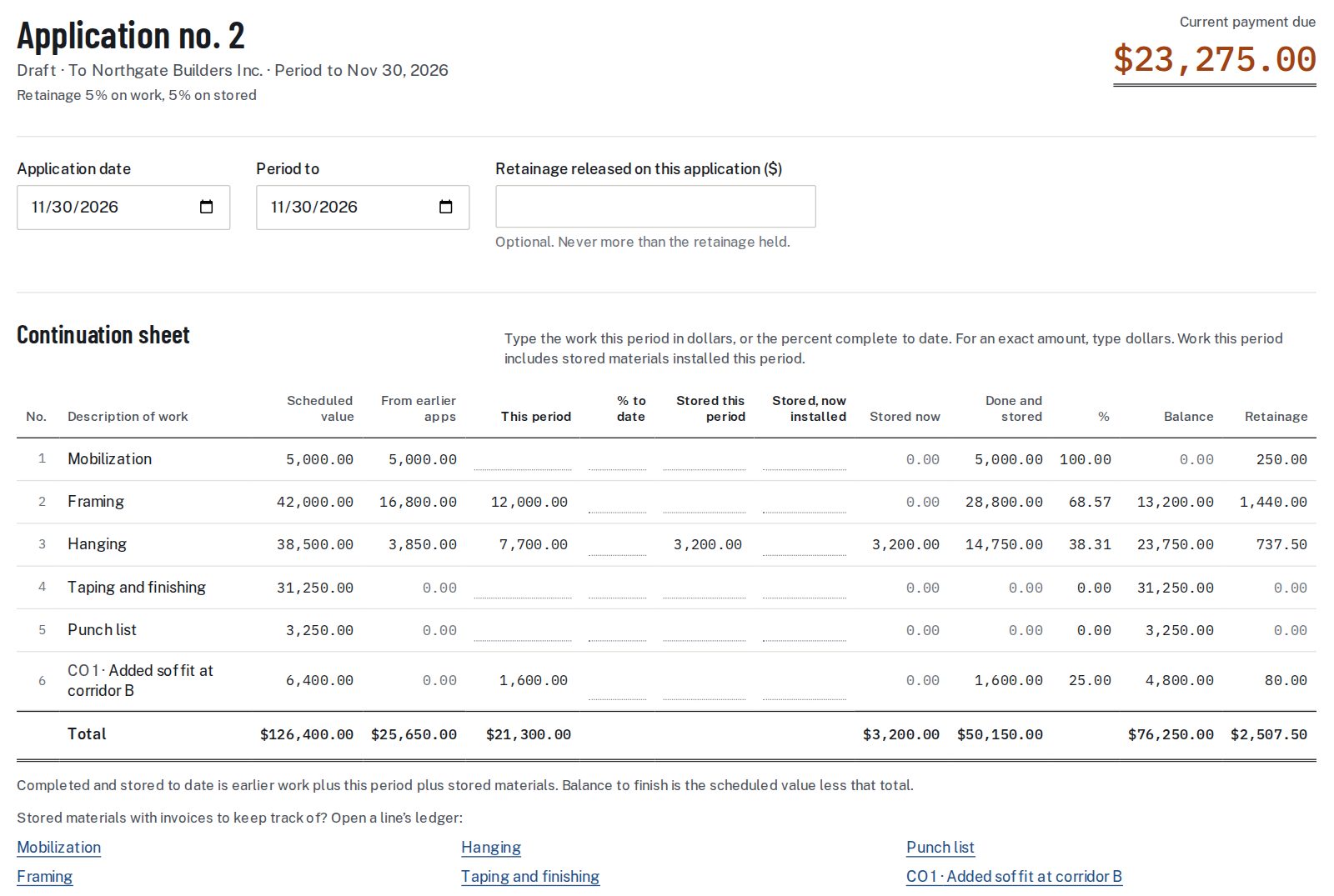
Progress billing leaves the choice of unit to the sub. On a line that is paid by the dollar, such as a delivery of switchgear, the sub types dollars. On a line that is a stage of work, such as rough-in labor, it is quicker to type the percent complete. The app takes either, rounds a percent to the cent of the line’s value and shows both figures, so the percent on the sheet and the dollars on the summary page agree.
Billing this way here
- Create the project with its contract sum and the retainage rates on work and on stored materials.
- Paste the SOV from Excel, or upload a CSV, and check the difference from the contract sum.
- Each period, enter the work done by dollars or by percent, and add stored materials.
- Check the summary page, finish the pay app, and make the lien waiver from it.
- Send one PDF with the pay app, the waiver and the backup files.
AIA billing questions
Is AIA billing the same as progress billing?
AIA billing is a way of doing progress billing: each period the sub bills the share of every schedule of values line that is done, less retainage and earlier payments. AIA Contract Documents’ article on AIA billing, read Nov 13, 2026, calls it a standardized process for payment applications.
What does AIA stand for?
The American Institute of Architects, which publishes standard contract documents and the pay application forms that GCs and architects know.
Does a sub need AIA’s own forms to bill this way?
The contract says which form to use. Where it names AIA’s forms, those are the ones it asks for. Where it asks for AIA-style billing or leaves the layout open, a pay app with the same fields follows the same method.
Is this app’s pay app an AIA document?
No. It is a G702/G703-style pay app in our own layout. It follows the same method, and it is not an AIA Contract Document.
How are stored materials billed?
On their own column of the continuation sheet, with retainage at the stored rate. When the materials are installed, the dollars move into work on the same line, and the app blocks installing more than was stored.
What carries forward from one pay app to the next?
Work to date on each line, the retainage held and what earlier pay apps asked for. They come from the last finished pay app, so a period’s billing starts from new work.
How does a change order get billed?
A change order signed by both parties changes the contract sum and becomes its own line on the continuation sheet from the next pay app. A deduction is a line with a negative value.
What does a GC look at on an AIA-style pay app?
Percent complete against the site, totals against the contract sum plus change orders, earlier work against the last pay app, and the backup the subcontract lists, such as a lien waiver and invoices for stored materials.
Sources: FAR 52.232-5, Payments under Fixed-Price Construction Contracts.
Related guides
See the pay application guide for a full month on a drywall job, the continuation sheet guide for the detail page, and lien waivers for the paper that goes with the payment.
Buying AIA’s own documents set against using software is laid out on the AIA forms software page.