 Simple Pay Application
Schedule of Values Examples, Trade by Trade
A schedule of values example is a contract sum cut into billing lines that add back to it to the cent. Seven are laid out below, one per trade: drywall, painting, electrical, concrete, roofing, mechanical and flooring, each with its own table and totals.
The jobs are sample jobs from our test set, figured to the cent. Read them for the way each trade chooses its lines and for the check that never changes: the lines total equals the contract sum to date, and the difference is $0.00.
The seven at a glance
Every example starts from a contract sum and ends with a lines total. The last column is the check: the contract sum to date less the lines total.
| Trade | Lines | Lines total | Largest line | Difference |
|---|---|---|---|---|
| Drywall | 5 | 120,000.00 | Framing, 42,000.00 | 0.00 |
| Painting | 4 | 23,456.78 | Finish coats, 12,345.67 | 0.00 |
| Electrical | 4 | 200,000.00 | Switchgear, 85,000.00 | 0.00 |
| Concrete | 5 | 168,500.00 | Slab on grade, 96,000.00 | 0.00 |
| Roofing | 4 | 120,000.00 | Membrane, 70,000.00 | 0.00 |
| Mechanical | 3 | 200,000.00 | Equipment, 120,000.00 | 0.00 |
| Flooring | 3 | 68,000.00 | Tile, 37,777.77 | 0.00 |
The concrete job is counted at its contract sum to date, $168,500.00, because two change orders have moved it from the $160,000.00 it started at. The other six have no change orders. Each line count includes change order lines where a job has them.
How a trade picks its lines
A GC pays against what it can see, so lines follow the order of the work or the things bought for it. A finishing trade such as drywall splits by stage. A trade that buys expensive equipment, such as mechanical or electrical, gives the equipment its own line, which also gives stored materials a place to sit. A trade with a short scope, such as flooring, may need only three lines. The examples below show each choice and the arithmetic that holds it together.
Drywall: five lines by stage
A drywall sub signs a $120,000 contract and cuts it by stage: a small mobilization line first, then framing, hanging, taping and finishing, and a punch list at the end. The punch list is the smallest line and is billed last.
| Line | Description | Scheduled value | Share of the contract |
|---|---|---|---|
| 1 | Mobilization | 5,000.00 | 4.17% |
| 2 | Framing | 42,000.00 | 35.00% |
| 3 | Hanging | 38,500.00 | 32.08% |
| 4 | Taping and finishing | 31,250.00 | 26.04% |
| 5 | Punch list | 3,250.00 | 2.71% |
| Lines total | 120,000.00 | 100.00% |
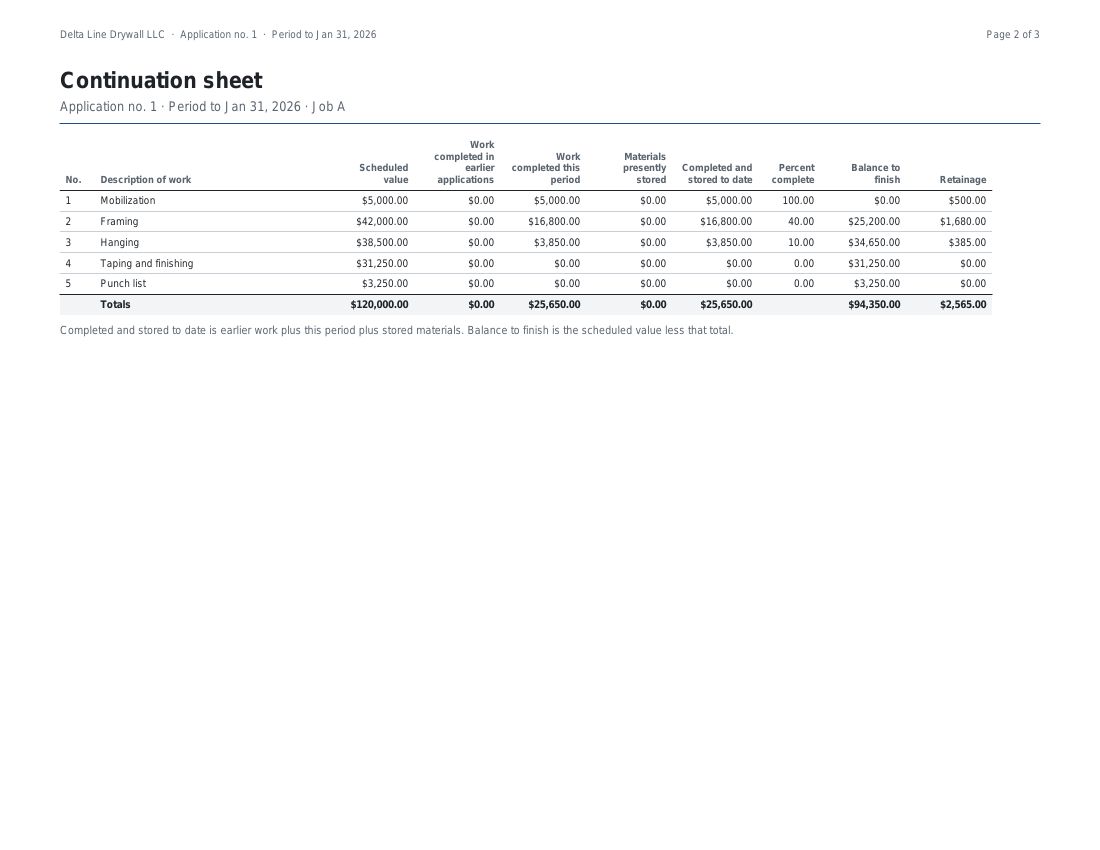
The lines tie out on the first day, and they keep tying out as the job is billed. Over three pay apps the work billed on each line climbs to its scheduled value and stops there.
| Line | Scheduled value | Pay app 1 | Pay app 2 | Pay app 3 | Billed in all |
|---|---|---|---|---|---|
| 1 Mobilization | 5,000.00 | 5,000.00 | 0.00 | 0.00 | 5,000.00 |
| 2 Framing | 42,000.00 | 16,800.00 | 21,000.00 | 4,200.00 | 42,000.00 |
| 3 Hanging | 38,500.00 | 3,850.00 | 23,100.00 | 11,550.00 | 38,500.00 |
| 4 Taping and finishing | 31,250.00 | 0.00 | 6,250.00 | 25,000.00 | 31,250.00 |
| 5 Punch list | 3,250.00 | 0.00 | 0.00 | 3,250.00 | 3,250.00 |
| Totals | 120,000.00 | 25,650.00 | 50,350.00 | 44,000.00 | 120,000.00 |
The three periods add up to the contract sum: $25,650.00, $50,350.00 and $44,000.00 come to $120,000.00. Every dollar of the schedule is billed once, and none is billed twice. A fourth pay app releases the retainage and bills no work at all.
Painting: a contract sum with odd cents
A painting sub has a $23,456.78 contract and four lines. Nothing about the sum is round, so the lines are not round either.
| Line | Description | Scheduled value | Share of the contract |
|---|---|---|---|
| 1 | Prep | 3,333.33 | 14.21% |
| 2 | Prime | 6,666.67 | 28.42% |
| 3 | Finish coats | 12,345.67 | 52.63% |
| 4 | Touch-up | 1,111.11 | 4.74% |
| Lines total | 23,456.78 | 100.00% |
Prep and prime together are $10,000.00, and finish coats and touch-up together are $13,456.78. The cents are carried by the lines, not left over. Splitting the sum into four equal parts does not work here: $23,456.78 divided by four is $5,864.195, and four lines typed as $5,864.20 add to $23,456.80, two cents over the contract.
Electrical: the equipment gets a line of its own
An electrical sub has a $200,000 contract in four lines. Switchgear is the biggest at $85,000.00, and it is bought early and delivered before it is installed. After two pay apps the schedule shows work in place and stored materials side by side.
| Line | Scheduled value | Work in place | Stored materials | Balance to finish |
|---|---|---|---|---|
| 1 Rough-in labor | 60,000.00 | 42,000.00 | 0.00 | 18,000.00 |
| 2 Switchgear | 85,000.00 | 60,000.00 | 0.00 | 25,000.00 |
| 3 Fixtures | 40,000.00 | 8,000.00 | 9,000.00 | 23,000.00 |
| 4 Trim-out | 15,000.00 | 0.00 | 0.00 | 15,000.00 |
| Totals | 200,000.00 | 110,000.00 | 9,000.00 | 81,000.00 |
Each row adds across: work in place, stored materials and the balance to finish make the scheduled value. For fixtures, $8,000.00 plus $9,000.00 plus $23,000.00 is $40,000.00. The totals row does the same: $110,000.00, $9,000.00 and $81,000.00 come to $200,000.00. Materials stored on a line count toward that line, and when they are installed the dollars move into work in place.
Concrete: change orders become lines
A concrete sub starts at $160,000.00. A change order signed by both parties adds a thickened slab at the loading dock for $12,500.00, and a second deletes an east curb for a $4,000.00 credit. Each is a line of its own, and the credit is a negative line. The table is read at the third pay app.
| Line | Description | Scheduled value | Billed to date | Balance to finish |
|---|---|---|---|---|
| 1 | Footings | 48,000.00 | 48,000.00 | 0.00 |
| 2 | Slab on grade | 96,000.00 | 96,000.00 | 0.00 |
| 3 | Curbs | 16,000.00 | 12,000.00 | 4,000.00 |
| 4 | CO 1: Thickened slab at loading dock | 12,500.00 | 12,500.00 | 0.00 |
| 5 | CO 2: Delete east curb (credit) | -4,000.00 | -4,000.00 | 0.00 |
| Lines total | 168,500.00 | 164,500.00 | 4,000.00 |
| 1Original contract sum | $160,000.00 |
| 2Net change by change orders | $8,500.00 |
| 3Contract sum to date | $168,500.00 |
The summary page shows the additions, $12,500.00, and the deductions, $4,000.00, apart, and their net is line 2. The lines total on the schedule is the same $168,500.00 as line 3. The credit lines up with the curbs: $4,000.00 of curb work is still unbilled, and the deduction is $4,000.00.
Roofing: one material line carries the job
A roofing sub has a $120,000 contract. The membrane is $70,000.00 of it, so most of the job rides on one line. Tear-off, deck repair and flashing fill in the rest. This is the schedule at the second pay app.
| Line | Scheduled value | Billed to date | Percent | Balance to finish |
|---|---|---|---|---|
| 1 Tear-off | 30,000.00 | 30,000.00 | 100.00 | 0.00 |
| 2 Deck repair | 10,000.00 | 10,000.00 | 100.00 | 0.00 |
| 3 Membrane | 70,000.00 | 55,000.00 | 78.57 | 15,000.00 |
| 4 Flashing | 10,000.00 | 2,500.00 | 25.00 | 7,500.00 |
| Totals | 120,000.00 | 97,500.00 | 22,500.00 |
The billed and balance columns add back to the scheduled value on every row, and the totals row gives $97,500.00 plus $22,500.00, or $120,000.00. This contract stops holding retainage once the job is half done, so the second pay app sets the rate on work to 0% and the $6,000.00 already held stays held.
Mechanical: odd cents on the small lines
A mechanical sub has a $200,000 contract and three lines. Equipment is $120,000.00, and the other two lines are cut to the cent so that they take whatever is left.
| Line | Scheduled value | Share of the contract | Billed to date | Balance to finish |
|---|---|---|---|---|
| 1 Ductwork | 55,555.55 | 27.78% | 41,666.66 | 13,888.89 |
| 2 Equipment | 120,000.00 | 60.00% | 90,000.00 | 30,000.00 |
| 3 Controls | 24,444.45 | 12.22% | 12,222.23 | 12,222.22 |
| Totals | 200,000.00 | 100.00% | 143,888.89 | 56,111.11 |
Ductwork and controls together are $80,000.00 exactly: $55,555.55 plus $24,444.45. Neither is a round share of the contract, which is why the shares are printed to two decimals. The table is the schedule at the second pay app, after the retainage rate changed partway, which the retainage guide follows line by line.
Flooring: percent entry and a correction
A flooring sub has a $68,000 contract in three lines. Tile and carpet are cut to the cent and together make $60,000.00; demolition is the remaining $8,000.00.
| Line | Scheduled value | Share of the contract | Billed to date | Percent | Balance to finish |
|---|---|---|---|---|---|
| 1 Demo | 8,000.00 | 11.76% | 8,000.00 | 100.00 | 0.00 |
| 2 Tile | 37,777.77 | 55.56% | 25,186.44 | 66.67 | 12,591.33 |
| 3 Carpet | 22,222.23 | 32.68% | 10,000.00 | 45.00 | 12,222.23 |
| Totals | 68,000.00 | 100.00% | 43,186.44 | 24,813.56 |
At the second pay app the tile is billed by percent, 66.67% of $37,777.77, and the carpet is corrected downward by $3,333.34 after being billed too high. Billed to date and balance to finish still add to the scheduled value on each row, and $43,186.44 plus $24,813.56 is $68,000.00.
Where a split goes wrong
| The split | What happens |
|---|---|
| Lines cut as equal parts of an odd sum | The cents do not divide. Four lines of $5,864.20 are $0.02 over the painting contract. |
| A subtotal row pasted in among the lines | It is read as a line of work, and the lines total runs above the contract sum. |
| A change order added into an original line | The original value no longer matches the last pay app. A change order signed by both parties gets its own line instead. |
| A deduction typed as a positive line | The lines total rises instead of falling. A deduction is a negative line, like the $4,000.00 curb credit. |
When the lines are off, the app shows the difference from the contract sum and blocks finishing until the SOV total equals the contract sum to date.
Starting your own from one of these
- Pick the example closest to your trade and copy its pattern of lines into a sheet.
- Replace the descriptions and values with the ones in your subcontract.
- Add the values and compare the total with the contract sum.
- Paste the sheet into the schedule screen or upload it as a CSV.
- Read the difference the app shows and change lines until it is $0.00.
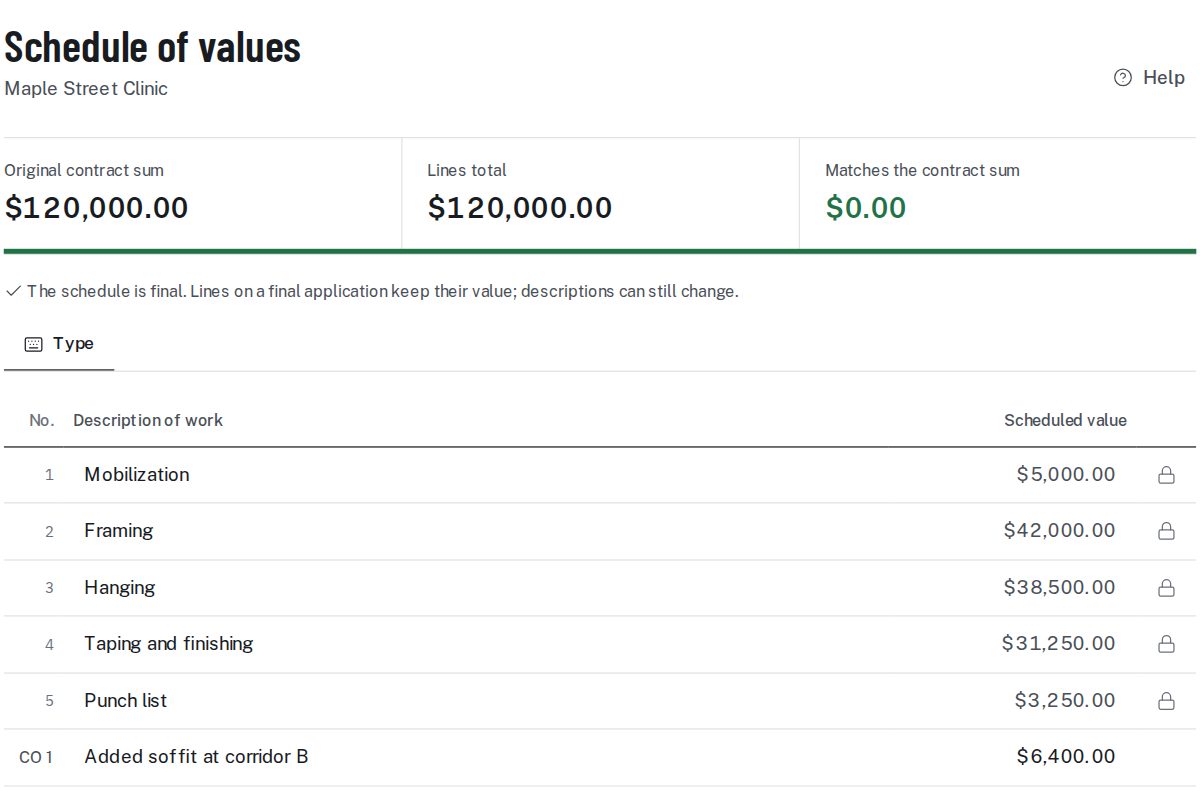
The schedule of values template page lists the columns the paste reads. Once the schedule is saved, each pay application bills these lines on its continuation sheet.
Schedule of values example questions
How many lines do these examples have?
Between three and five original lines, plus change order lines on the concrete job. Flooring and mechanical use three, painting, electrical and roofing use four, and drywall uses five.
Do the lines have to be round numbers?
No. The painting job has a $23,456.78 contract and lines such as $3,333.33 and $12,345.67. The lines need to add to the contract sum to the cent, and nothing else about them is fixed.
Why does the concrete job have a negative line?
A change order that deducts from the contract becomes a negative line. In the example, the deleted east curb is a $4,000.00 credit, and the contract sum to date falls with it.
Can I copy one of these schedules into the app?
Yes. Copy the lines into a sheet, change the descriptions and values to match your contract, and paste the sheet into the schedule screen or upload it as a CSV.
Where do stored materials sit in the schedule?
On the line of the item stored. The electrical example shows $9,000.00 stored on the fixtures line next to $8,000.00 of work in place, and both count toward that line.
What if my lines add up to a few dollars off?
The app shows how far the lines are from the contract sum and blocks finishing until the SOV total equals the contract sum to date.
Do these figures come from real jobs?
They come from sample jobs in our test set, which the engine is checked against to the cent. They are not any customer's jobs.
Sources: FAR 52.232-5, Payments under Fixed-Price Construction Contracts.
Related guides
The schedule of values guide explains the tie-out and the terms, and retainage release follows the drywall job to its last payment. AIA billing in plain terms covers the method behind billing by line.